Search This Blog

I am a quilter living in Woodbridge, Suffolk who has made quilts since I was a teenager. I also ring bells! Both are great British traditions....I will try to feature some of my antique Welsh and Durham quilts, the quilts I make myself, my quilting activities and also some of my bellringing achievements. Plus as many photos as I can manage. NB: Double click on the photos to see greater detail, then use back button to return to the main page.


Showing posts with label RIB. Show all posts

Tuesday, 20 March 2012

Worn Pink Quilt from Pontardulais

This quilt arrived in a very sorry state! I was kindly given it by Enid Davies of Creigiau, via Nerys Horrocks (a quilter from Essex who I know through the Quilters Guild).


The quilt is very well used and had been sitting in a garage for some time. The first step was to wash it in tepid water and some Synthropol ( a mild detergent).


I then spun it to remove as much water as possible and laid it flat on polythene on the floor, turning as often as possible.


The quilt is similar pink cotton sateen on both sides. It has some typical patterns on it - a central medallion with a four lobed flower surrounded by spirals - more spirals - chevrons - triangles filled with spirals.


A closer look at the centre of the quilt.


You can see how worn it is at one end, where the worn white woollen blanket peeps through. The ends and corners of a quilt always receive the most wear.


Enid's mother lived with her grandmother who was named Mary Elizabeth Jones. Mary belonged to the Pontardulais group, near Swansea, who quilted commercially for the RIB (Rural Industries Board) in the Depression. Mary helped to make quilts for the Claridges order.


Both grandmother and mother went to classes in the 50's - taken by her aunt Eira Rees. Mostly small items such as cushions were made. Her father made the frames and took them to the classes.


The family still retains the nicest quilt. Other quilts and narrow loom blankets were sold to Jen Jones. This quilt had been in the garage for many months. It is old and the family doesn't really know who made it.


The quilt measures 64 x 78 inches and is of interest because it is very typical of the type of quilt that would have commonly been used on beds at the turn of the century. Many thanks to the family for giving me this quilt.

Saturday, 6 November 2010

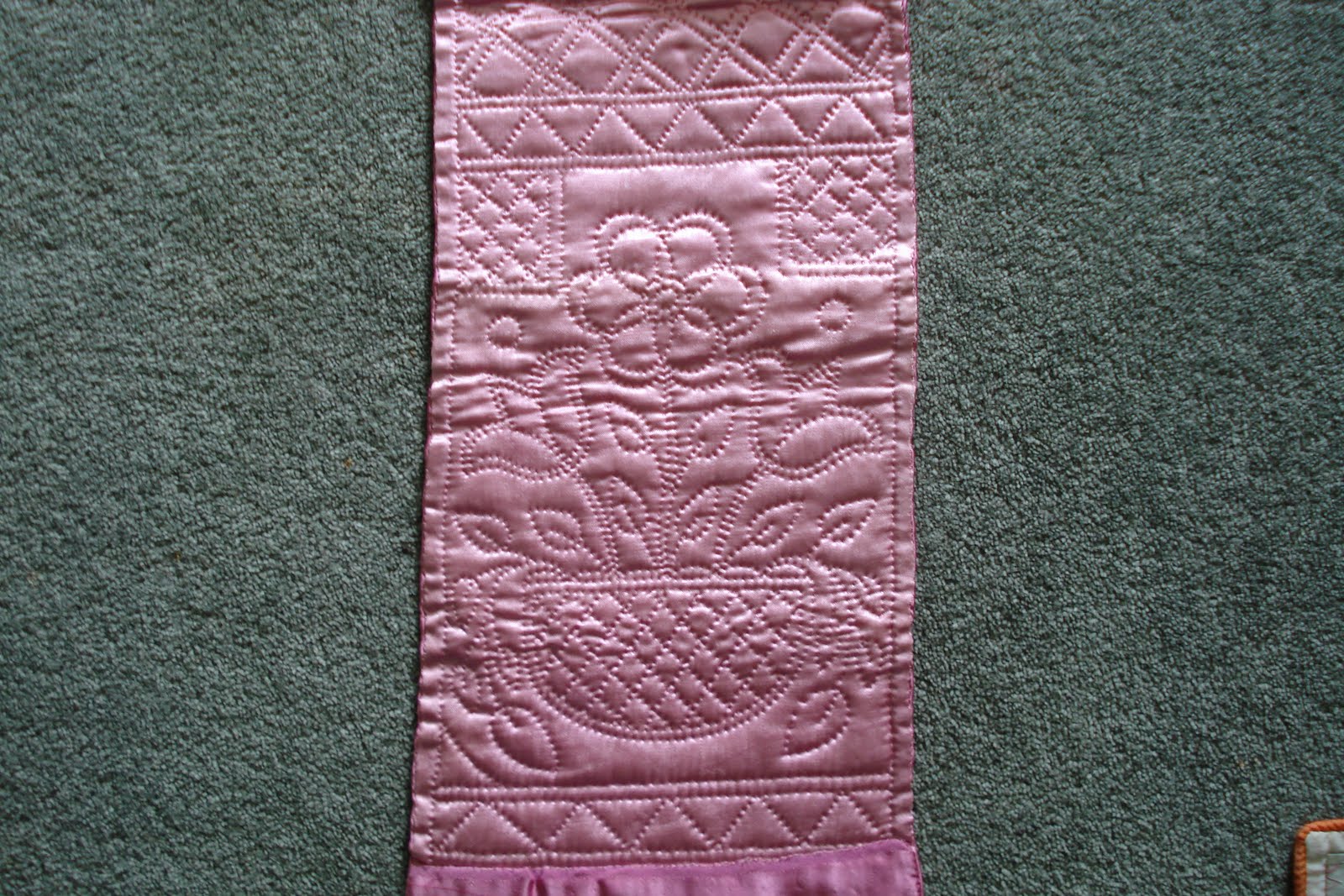
Pink Quilting Sample

You may remember this sample of quilting that I mentioned in an earlier post.
It is of pink fabric with a Welsh-looking pot of flowers motif. The samples came from a seller in Devon, and it was supposed that they might be Rural Industries Board samples - Devon was a hotbed of activity for the WI and several people who lived in Devon were involved in the RIB scheme.

Not long ago I had an email from Clare Claridge - "Wanted to let you know that the pink quilt in the April blog looks like the work of the Porth Quilters about 1933 under the RIB scheme, See Chris Stevens p 38 and Elizabeth Hake Fig 57"

This was very interesting and sent me off to find the two books. It was difficult to find the Stevens book - it is a very slender book and required several searches- did I actually own a copy?I finally found it.... also the Hake book. The two photos seem to be of the same quilt. Also in the Hake book in the acknowedgement, one can see that several of those thanked are in Devon - not surprising in a book concerning West Country quilts - but it does show that there was an interest in quilts in Devon before the war.

It also made me want to find out more about the Porth Quilters.

As one does, I looked with renewed interest at all the plates in the Hake and Stevens books - and made what I think is an extremely interesting find - more in the next post....

Tuesday, 13 April 2010

Welsh quilt types


Pepper wondered if there was a definite Rural Industries type Welsh quilt. Here I attach a photo of the RIB quilt (30's-ended 1939)that was shown to us at the Quilt Study day. Welsh quilts had previously been made, of course, according to how much the person wanted to spend - there were the common quilts and also the "better" quilts. But becauseof the prevailing poverty, prices were very low in Wales, hence standards were generally low. The RIB were marketing to wealthy people, especially in London via The Little Gallery and others, so the fabrics had to be of the highest quality and also the workmanship had to be very good. Some of the young girls had no previous experience but were trained in quilting. Other quilters submitted samples and were accepted into the scheme. So the designs were perfectly drawn on (no freehanding like in country quilts) and the quilts very symmetrical and rather formulaic.No individuality. One comment was that they were "souless" although I thought it rather lovely. A point made was, that the quilts were bought for good prices, but in an act of charity, these quilts were considered rather rustic and often, once bought, were not used but put away. Hence come to us in good condition. The quilt in the foreground in brown is the RIB quilt, I think the one in the back is the "Country" style quilt. I also attach a photo of a real country quilt which I love. Also a quilt of the same era (1930's) which Clare C. has identified as being by Margaret Williams or one of her students, it is in her characteristic style.

Pippa