Search This Blog

I am a quilter living in Woodbridge, Suffolk who has made quilts since I was a teenager. I also ring bells! Both are great British traditions....I will try to feature some of my antique Welsh and Durham quilts, the quilts I make myself, my quilting activities and also some of my bellringing achievements. Plus as many photos as I can manage. NB: Double click on the photos to see greater detail, then use back button to return to the main page.


Saturday, 17 March 2012

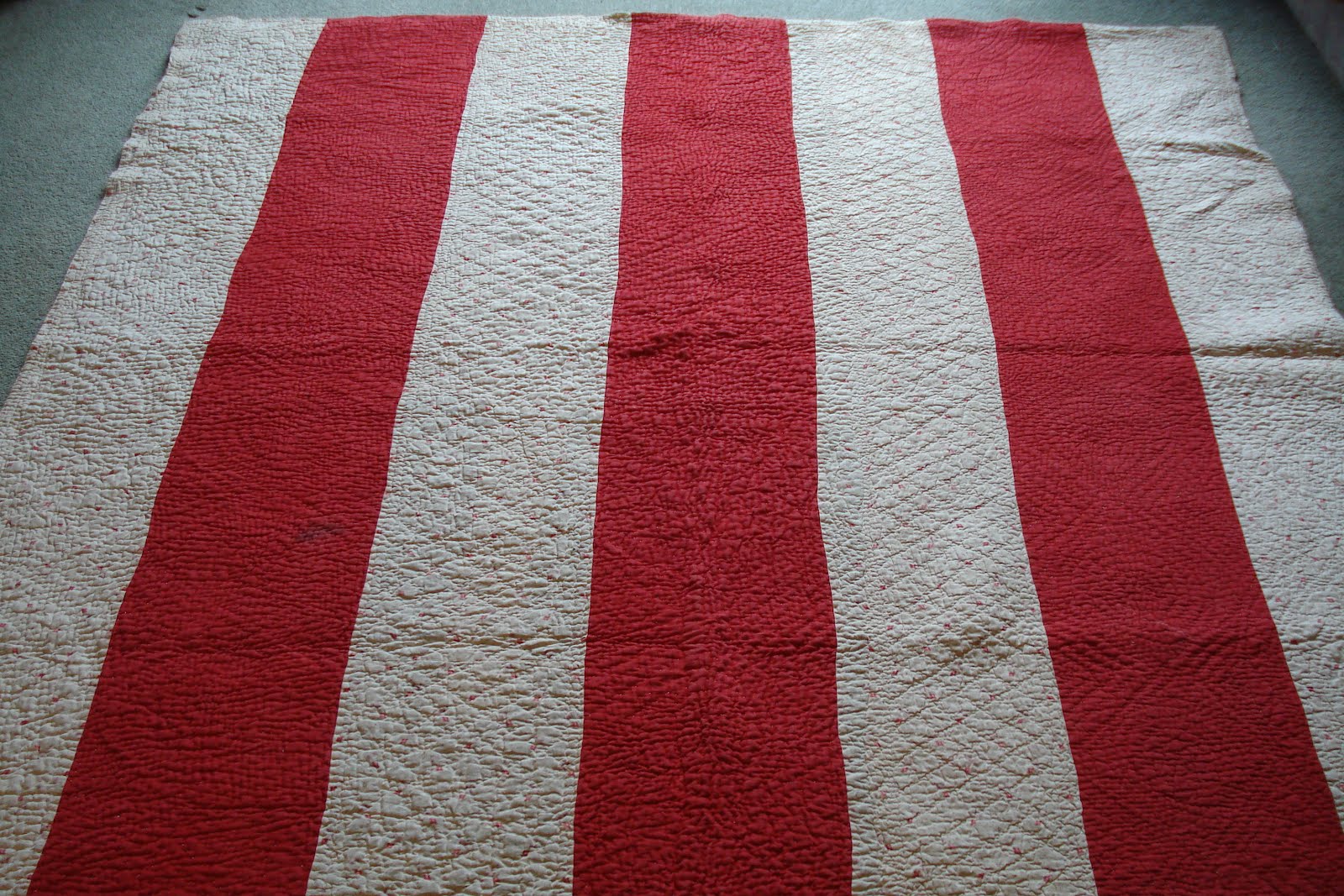
Red and White Welsh Strippy

Here is an older Welsh strippy in red and white (actually a white print with small flowers). The back is a plain white fabric. Again it is "Victorian" in age - I guess this means 1890-1900? The size is 78 x 72 inches. It is rubbed at one end and you can see a dark coloured woollen blanket inside.

You can see that the strips are much wider in Welsh strippies than their North Country counterparts. The quilting designs are pleasant and functional.


One design has squares infilled with spirals.


Another border has half circles - a form of Church Windows but without the overlaps...


Here you can see the blanket peeping through - this quilt has been well used...


Another photo of that border design of half circles....


There is a central medallion - it is a bit hard to see but it is a series of concentric circles which echo the border design. Some of the strips have crosshatching on them.


The quilting shows up well on the reverse.


This quilt amused me - the dealer, Geoff B from Brecfa, bought it at an auction and said of the quilt "it is a Cardiganshire one & very old. A lady had it over her legs in a very cold auction - as she was leaving a long time before me and I was perished to the bones I asked her if she wanted to sell and she did...it stopped my knees knocking but not my teeth chattering...Cheers Geoff.


Later he also wrote "The lady I purchased it from was just in front of me with her husband and they were wrapped up in it - most people that day had blankets. It looked like a scene from a Russian outdoor prom, I stood from 9 am to 6 pm in a sub zero shed without any heat. When they got up to go I asked if they wanted to sell, ever the opportunist me. I would think that it was a local quilt - Carmarthen.


If I lived in Wales it would be fun to go to these auctions....

Wednesday, 14 March 2012

Lively Paisley and Plain Pink Welsh Quilt

This Welsh quilt has a lively paisley print on one side and a plain pink fabric on the other. The quilting is well executed with some nice patterns to be seen.


The central motif is a flower? or lovers knot??, this is surrounded by double diamonds. I am constantly surprised by the variety of patterns seen in Welsh quilts!


The outer border is of circles with a design which might be orange peel or might be beech leaves - hard to tell. I was also surprised to see - plumes or feathers. I had, up to now, thought that there were no feathers to be found on my Welsh quilts - but have a look - pairs of plumes at either end of the quilt---


A closer look at the pair of plumes - or are they supposed to be ferns?? I thought feathers had rounded edges whilst leaves had pointy ends which would make these feathers....


The pair of plumes at the far end of the quilt - very handsome but seemingly not double outlined like the last pair. Quilters worked quickly across the frame - by the time they reached the far side of the quilt, the first side was wrapped onto the poles and quilters could forget exactly what they had quilted - so motifs often are slightly different on either side...


A close up of the paisley print which has quite a lot of yellowy-green and blue colours against a pink background - quite different from the reproduction fabrics that we get today!


The quilting is not very visible on the paisley side but it is cheerful on the bed. I have a "comfy" quilt on my bed and usually have just the paisley side showing - as I prefer the effect - looks nice and warm in the winter!


A close up of the central design.


This quilt was bought from a seller in Epsom and had no provenance.

Monday, 12 March 2012

Ringing Outing to Norfolk

On Saturday, Mike and I went to Norfolk to help Paul Norris and his band of learners from Brooke, on their spring ringing outing. Of course it is much easier for the learners if they have experienced ringers around them. And sometimes there is another person "standing behind" to give advice and help.

The first tower is one that I have a great affinity for - St Mary's Redenhall. Mother's maiden name is Fuller - there are many in the US! Samuel Fuller and his brother Edward were passengers on the Mayflower and came from Redenhall. Their father Robert was a well-to-do Butcher in Redenhall, and was one of the subscribers who donated money for the 6th bell. So I feel a real connection here. Not only ancestors, but an ancestor that liked the bells and possibly was a ringer.


The second stop was Starston with six bells. More Fullers lived here, also
Samuel's first wife (it seems he went through several).


Then we went on to Pulham St Mary - I had to stop in the local shop Bossy Boots for a snack here, as I was getting hungry! Eight bells here. The stairs caused alarm among some ....but we managed to ring Grandsire, Cambridge and Stedman .


Lunch was at the Crown in Pulham Market.


Ringing at Pulham Market after lunch - these bells will be out of action this summer as work starts on the tower and also the bells. Most church congregations have to work hard to raise money for costly repairs to mediaeval buildings....


Then on the Forncett St Peter - a round tower. These are characteristic of Norfolk, although there are a few to be found in Suffolk. This one had four old bells and two new ones. A sonic bat repeller did not seem to work, the bats had returned and the alter was covered with a protective cloth. Bats are of course protected by law as endangered animals so cannot be directly interferred with although they do make a mess.


The last tower was Carleton Rode, six light bells here. A church mouse was spotted here...


Spring is on its way and there were wildflowers to be seen in the churchyard including Celandine...


..... and Primroses.


Next Saturday, I hope to go to the quilt study day organised by Region 9 at Swaffam Prior near Cambridge. I'll try to take some photos to share.

Saturday, 10 March 2012

Dark Paisley Welsh Quilt

Here is a very traditional Welsh quilt - not a "best" quilt, but one that would be used on the bed. The fabrics used are the dark paisley prints that the Welsh seemed to favour, and the filling is a wool blanket.

This quilt measures 80 x84 inches. Each side has a different paisley print with a dark background. The quilting is a simple diamond crosshatching.


A closer view of the diamond quilting.


Closer view of the print - more of a floral than a paisley, I guess.


You can see that the other side is a different fabric. Although this quilt was sold as "unused" I think that the fabrics are faded and would originally been much more colourful, as they would have had brighter reds and greens in them.

No provenance on this quilt, although the seller was from Swansea.


Closer view - oh yes, some paisley shapes visible on this side! The edge is a neatly handsewn knife or butt edge.

Wednesday, 7 March 2012

Pink and Blue Welsh Strippy

Here is a Welsh strippy in pink and blue that has nice traditional Welsh stitching. The size is 70 x 87 inches and the filling is a thin carded wool.
This quilt is all hand sewn - there is no machine sewing. Even the strips are hand pieced.

There are some very attractive patterns to be seen - I especially like the Church Windows with infill spirals...chevrons surrounding stars above....


A view of the whole quilt - you can see how wide the strips are, much wider than in the North Country strippies.


The central motif is a lozenge shape formed by the four corner fans surrounded by bands of sprials - this centre shape is filled with cross hatching.


The fabric in this quilt is not sateen but a cotton poplin, which has a plain weave. In contrast to the showy and shiny sateen, it has a muted, matt effect which is most attractive.


The other side of the quilt is also a strippy - it is reversible and the strips are the opposite colour - very economical to run up, nothing wasted.


This quilt was bought from a dealer - I finally managed to coax the details out of her. The quilt came from a farmhouse owned by the Howell family at Byntag, at Cynwyl Elfed above Carmarthen. It was made by the seller's grandmother who had considerable skill and may have been a seamstress.


This quilt was one of a batch of my quilts which were sent off to France - they were shown at a quilt show as Les Quilts Gallois. The show was organised by Jane Rollason who now lives in the Charente.

Sunday, 4 March 2012

Corded Quilting Pattern

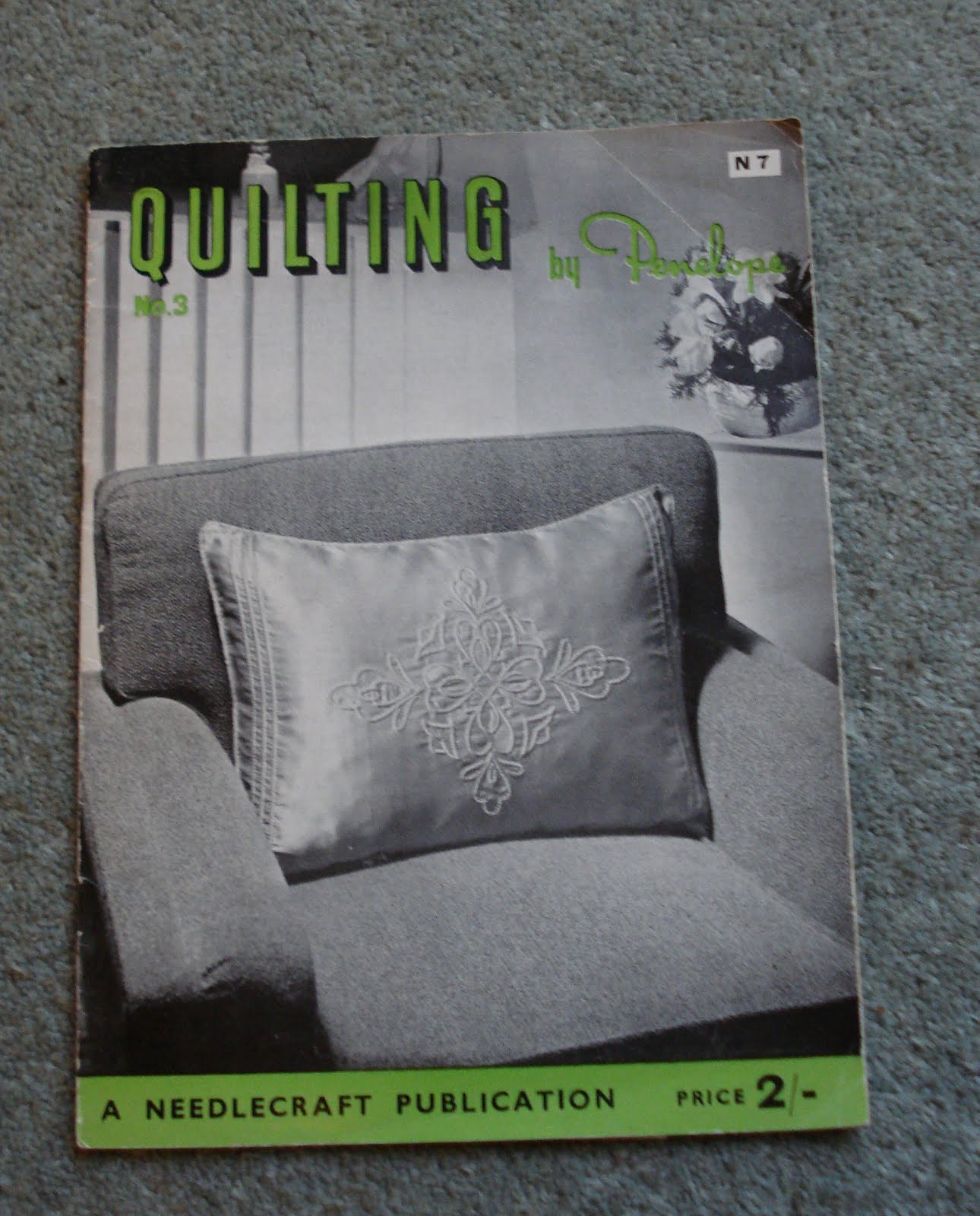
Some time ago, I blogged about these corded or Italian quilted pillow covers from Wales. I thought that these were made from patterns but wasn't sure.


I can now show an example of the type of patterns that were available after the war. The trend was to make small projects, and to use a pattern - which were readily available, and inexpensive. This little magazine is by Penelope, and contains designs which are very similar to the one on the cushion above. I have seen another book which contains different corded patterns, so evidently there were several pattern books available.


A picture of the clever seamstress of the day...


The owner of this booklet evidently took a class in quilting, as there is a sheet of class notes....I suppose that after the war, quilting had ceased to be a practical skill and had become a leisure activity; the object was to make a beautiful object for the house and picking out a pattern with clear instructions was vital, as skills had been forgotten by most women at this time.

Thursday, 1 March 2012

Green and Gold wholecloth Welsh Quilt


Welsh wholecloth - Green and gold - Edith Jones - Victorian in age


Here is a beautiful whole cloth that shows the true skill of the Welsh quilter. It is one of my personal favourites. The colours are much nicer in reality than in the photos. - a fairly typical and popular avocado and rich gold combination, in cotton sateen with a thick welsh blanket as a wadding. Wales had a great number of woollen mills and a worn woollen blanket was a common filling for a quilt. The quilts are very heavy, very stiff and very warm!! And it has been said, tongue in cheek, that they acted as a natural birth control - as you couldn’t move very much once underneath.


This quilt was bought from a favourite dealer from Cardiff, and is the same dealer that sold me the Margaret Williams quilt. The size is a generous 74 x 86”. The lengths of cloth are sewn together by machine although the edges are neatly finished off by hand. This quilt, although a bit sun faded along fold lines (the dark fabrics seem prone to this) seems unused so must have been kept for best - or - considered old-fashioned and not used?


The quilting has been done in a stout green thread to match the top side (you can tell the top side as the quilt is flatter and the stitches more even than the reverse). This quilt was made by a professional quilter in a frame. I am told that due to the thickness, a thick thread like carpet thread was used, and also a stout darning needle, not a tiny quilting needle. I tried a sample of quilting with a blanket and I did not find it an easy task to sew although the effect was not bad.


The quilting patterns are nice and well set out. Evidently the fields were marked out with chalk as well as the larger motifs, and the rest was either marked with chalk or sewn freehand. The quilter was working swiftly so if she ran out of space ,she improvised. I have traced this quilt, and you can see this in the spirals around the central motif - in one place where there was no space left for a double spiral, the quilter has put in a single spiral. The style is called “Boxy Carmarthenshire” and there are many geometric patterns, including chevrons, double diamonds and triangles. There are many spirals and spiral rams horns. The centre is a large square of double diamonds made up to a circle by means of half moons, then surrounded by a band of spirals. Note how the corner motifs echo the central motif.


Also to be seen in one corner of the edge is a name tape “Edith Jones” - probably the quilter - but possibly - the owner of the quilt. I have a Durham whole cloth with a similar name tape so evidently they were not unusual. Amy Emms had similar tapes made up in the 1960’s, however it seems that she only used them for larger items. Some of my cottage quilts have embroidered initials, however, signing a quilt in any way seems the exception rather than the rule.


The quilting on this quilt illustrates the sculptural quality of the Welsh whole cloth quilts - I love it.