Search This Blog

I am a quilter living in Woodbridge, Suffolk who has made quilts since I was a teenager. I also ring bells! Both are great British traditions....I will try to feature some of my antique Welsh and Durham quilts, the quilts I make myself, my quilting activities and also some of my bellringing achievements. Plus as many photos as I can manage. NB: Double click on the photos to see greater detail, then use back button to return to the main page.


Monday, 6 June 2011

In the Post Today

A pleasant surprise today - the postman rang the doorbell with these to deliver - two trophies from Quilts UK at Malvern. Apparently I can keep them for a year and then have to return them next March.You can see that the hand quilting trophy is much larger than the hand applique one!


That's Monkey checking the object out - and my quilting frame is the white object behind.

Past winners of the Hand Quilting award include Liz Jones, Gwenfai Rees Griffiths, Sandy Lush, Jaqui Harvey and Susan Briscoe, so I am flattered to have won it.

I was pretty tired after my visit to York for the Saturday Treasurer's training session, so I had to spend yesterday resting. Back to the grindstone today! I was pleased to see the current exhibitions at the Museum - and I am of a mind to join the 100 club to sponsor the YQ officer's salary - now that the Hollesley Tower one is just about finished it will make a good replacement for that monthly £10.

Friday, 3 June 2011

Ringing World Article

Finally! the Ringing World article about the "Bell Quilt" appeared in last Friday's issue. I have had a good response and it is interesting to see that there are other quilters/ringers about.

The article also appeared in the online version, which is how many outside the UK now receive their copies.


Progress on the sawtooth quilt - the white border is now finished (only partly complete in this photo) and I have started on the pink braid border. Not only is that rather more tedious, but the markings are more difficult to see on the pink cloth, especially at night.


The pink braid border - markings on the braid are not very regular - I get a feeling that there was a template used to mark the outer lines and central square, then the rest was filled in freehand - but I've decided to go with all the markings as they appeared and not to "titivate" any of the designs.


and here's what happens if you use a thimble a very lot - the needle eventually pierces it, as on the left. These thimbles with a rim around them (a quilter's thimble) are my favorites - and I've tried a lot! It's always worth trying a variety of thimbles, as everyone has their favorite. But I find one with a rim essential to hold the needle in place while picking up more than one stitch.


Last night, I gave a talk on Welsh and Durham quilts to the Mole Valley Quilters in Bookham, Surrey. I lived there for a year - from 1984-85 - and it doesn't seem to have changed very much - even the old house on Dawnay Road didn't appear any different. I was also pleased to be able to drop in to visit a colleague from Kings College days, Pat Wiltshire, who now is one of the country's top forensic scientists, specializing in forensic botany - pollen grains and fungal spores a speciality. Was able to meet her husband David as well. As I had set off from Suffolk in good time to miss the rush hour traffic on the M25, I was glad of a cup of tea and a bite to eat. Thanks, Pat!

Thursday, 2 June 2011

Light Blue Allendale Quilt

In spring 2009, I bought an old North Country quilt that was in very poor condition. The quilt had been purchased at Tyneside Market after a house clearance - the quilt was very faded and grubby although not smelly or damp. It was as if it had been left in a shed or loft for a long time. It had stains and some paint on it, and an area where the wadding had entirely disappeared.


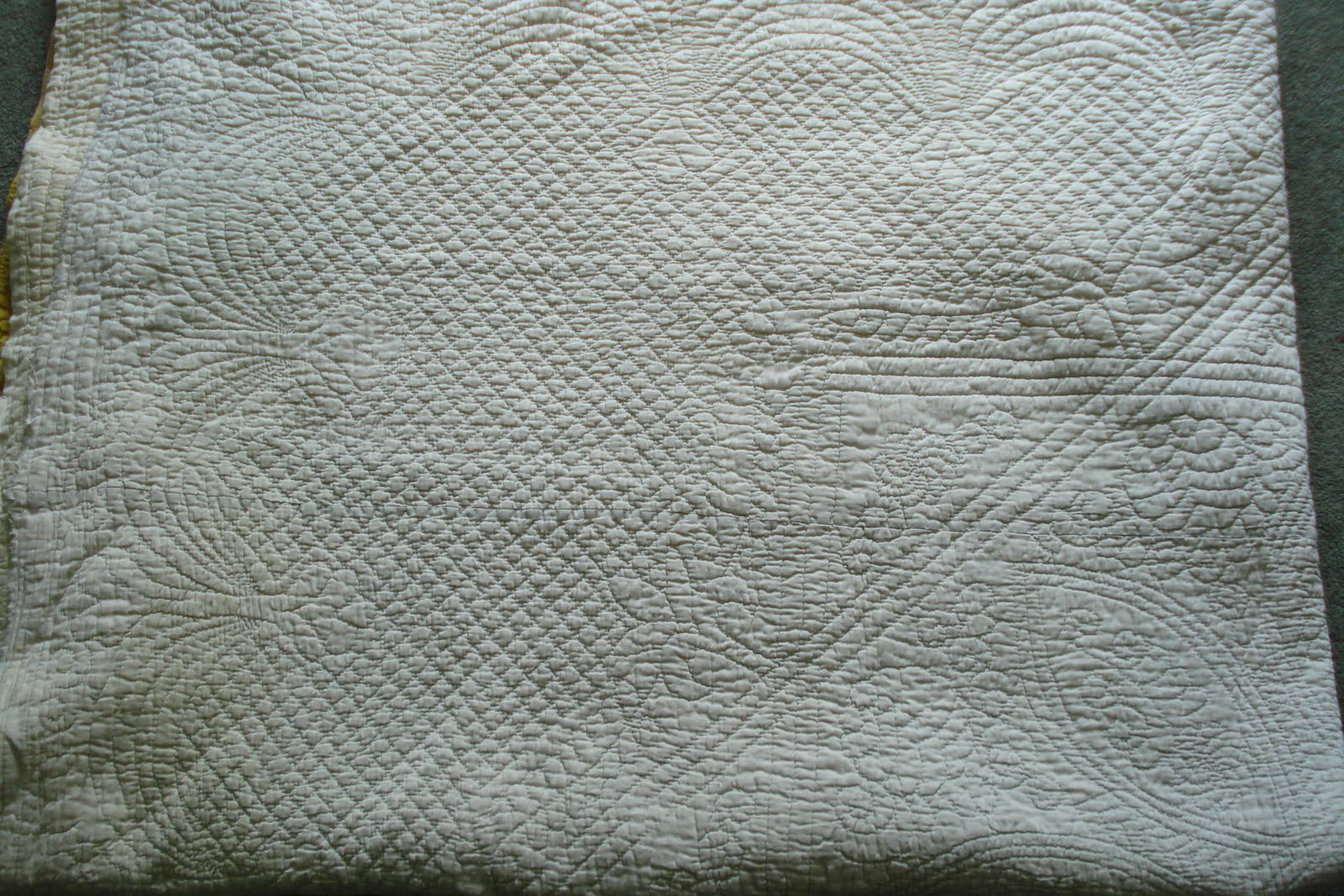
The centre of the quilt


My first action was to wash the quilt in a tub with some Synthrapol detergent, and clean tepid water. Several tubfuls of dirty water later, the quilt was much cleaner and could be carefully spun and then dried. Although it was still rather stained, one could see that it was very nicely quilted. Over the years, the quilt had faded to a pale blue, but by looking in the seams one could see that it had once been a mid blue colour. The quilting patterns were very attractive and it was apparent that the designs had bee professionally "stamped" or drawn out, although no markings remained after years of use and washing.

I found a very similar quilt illustrated in the Beamish Museum's book Quilts and Coverlets, which had been stamped in 1910. The patterns on my quilt were not identical, but as quilt designs were largely drawn freehand, few are exactly the same.


I decided to trace the quilt patterns onto polythene sheeting using a permanent marker. The design was roughly rectangular with swags, roses, feathers, ferns, spirals and elaborate pomegranate-type designs, The centre treatment was especially pleasing. The pierced ferns are very characteristic of Allendale quilts, as are the border swags.


The corner treatment - note the swags with roses at the junctions and also in the corner. In the centre of the corner is a fleur de lys design with much freehand scrolling. Note the hand-drawn feathers underneath the swags - very characteristic of Allendale quilts. The background grid is neatly drawn , 3/4 inch squares on point; again this was difficult for most home quilters to do but was carefully and neatly done by the apprentices in the Allendale workshops.


I later decided to make a new quilt - more in the next post!

Wednesday, 1 June 2011

Quilts UK -Malvern May 2011

Phew!! I was so glad that the two quilts that went off to Malvern have arrived home safely today.

And I am pleased to report that the red and white Hawaiian quilt Kaui o na Molokama was awarded a Judge's Merit and the Award for Hand Applique.


And the New Allendale Quilt was awarded a Judges Merit and the Award for Hand Quilting. I am so glad that two very traditional quilts won prizes - sometimes I think they get forgotten among the more modern and more exciting quilts....


But as I did not attend the show in person, I can't say any more! Unfortunately, Malvern is a 200-mile, four hour drive away from Suffolk. The judges marking sheets (always interesting to view) were not enclosed (as with the FOQ entries) - and no catalog either. I would like to have seen the other quilts - perhaps one day....

Monday, 30 May 2011

Allendale Quilt Designs

The Gardiner style is instantly recognisable, but as these quilts were marked by hand, there are no two identical patterns. In her book "Traditional Quilting", Mavis Fitzrandolph says that Gardiner evidently had a good understanding of what would be effective in quilting, and a remarkable talent for design.


These "complicated and elaborate" quilts generally have large central motifs, with much freehand curlicue infill. The centre is rarely confined, but instead "flows" into the central field of square diamonds. Elaborate corner motifs are present, with borders of swags or goosefeathers. Elizabeth Sanderson was said to be able to mark one or two of these tops per day with the help of her assistants, thus thousands must have been produced over the years. Certainly, large numbers of quilts in this style have survived.


Generally, while everyday patchwork and strippy quilts were "hand laid" or marked in the frame at home, more special quilts were sent away for marking. It is therefore supposed by Fitzrandolph and others that most local quilters lost the ability to draw out the more complex patterns, or to turn the corner in a border. Indeed, many of the later wholecloth quilts have more simplified designs and lack the elegance and skill of the earlier, Gardiner-style quilts marked at the turn of the 20th century.


Allendale quilt with swags and central design with flat-iron motifs.


White Allendale quilt with swags and fleur-de-lys motif and elaborate corner design.

Friday, 27 May 2011

Allendale Quilt Stampers

I am going to begin a series of posts on Allendale quilts - these are the quilts that were marked by professional quilt "stampers" in the Allendale area of Northumberland. Over the course of several posts, I will relate some background information, and then present several stamped quilts to you.


Allendale, in the northern Pennine Dales, Northumberland, was an important lead mining area, but also famed for its experienced quilters. As the mines declined after 1860, many people emigrated or moved elsewhere in search of work. Those who stayed had to find other sources of income.

George Gardiner was a successful shop owner and hat-trimmer in the village of Dirt Pot. He became famous for his quilt designs, developing a quilt format that would be used for the next 100 years. He had many apprentices, the best known of whom was Elizabeth Sanderson, who worked from c. 1875 to her death in 1934.


These quilt designers were called stampers because it was commonly supposed that there was a special transfer method to put the blue markings onto the cloth. In fact, a durable blue pencil that would not easily rub off was used for the marking. The markings had to withstand parcelling, posting, peddling and finally quilting, sometimes by inexperienced quilters. the markings did eventually come out, although many quilters were proud of having a specially marked quilt and preferred to keep the quilts unwashed.

Saturday, 21 May 2011

Magenta/Deep Pink Durham

I don't know how to describe the colour of this quilt! In some lights, it looks a purple or magenta colour, in artificial light it looks like a deep pink colour. But it is very nicely stitched and designed, and looks unused, as if it were simply left folded up and stored away.The size is a generous 85 x 95 inches. No provenance, but the quilt came from a dealer in Teeside, Cleveland.


Here is the central medallion, very striking with a star effect sprouting shell motifs. The centre circle has concentric circles and there is crosshatching (smaller than the background grid and different orientation) to complete the effect. This rather looks like a petal/flower shape as well as a star. Notice how the motifs have been double outlined for emphasis.


Here you can see that the two sides are different shades of pink/purple - light and dark, as is usual in north country quilts.


The outer border is a fan or shell (pecten or scallop shell) pattern. You can see that there is a slight fade here and there where the sun caught on the folded quilt. Again, the shells have been double outlined.


The stitching is very nicely done, probably a professional quilter. The panels are machine stitched and there is a machine sewn line around the edge (this made for a firmer edge).


Quite a simple design, with only a few motifs and a lot of background stitching. I don't think this is of any great age - probably 30's or 40's. But it is what I would call an honest, better quality Durham quilt. Someone thought it was too good to use - or did they prefer their store bought blankets?