Search This Blog

I am a quilter living in Woodbridge, Suffolk who has made quilts since I was a teenager. I also ring bells! Both are great British traditions....I will try to feature some of my antique Welsh and Durham quilts, the quilts I make myself, my quilting activities and also some of my bellringing achievements. Plus as many photos as I can manage. NB: Double click on the photos to see greater detail, then use back button to return to the main page.


Showing posts with label Ralli quilt. Show all posts

Tuesday, 17 January 2012

Indian Quilt from Sindh

Here is a quilt that I bought before Christmas. It is a vintage Indian quilt but the seller knew very little about this quilt. It is rectangular (sort of) and the measurements are about 70 by 42 inches. It is at least 30 years old and is in purple, claret and yellow fabrics with embroidery in threads of various colours.

A long quilt - so only one half shown here. The embroidery gives this quilt a very rich surface texture. In Patricia Ormsby Stoddard's book Ralli Quilts the quilts which most closely resemble this quilt are those on pages 80 - 82. These are embroidered ralli quilts, from the tribal group known as Jogi, Lower Sindh. Thick coloured thread defines the patterns, in a step stitch. The fabric is cotton.


The ends of the quilt are not square, giving a charming effect. These ralli quilts were made from recycled materials, however recent quilts are made from purchased fabrics.


There is an immense amount of work in this quilt. Also to be seen are small areas of satin stitch, used as accents.
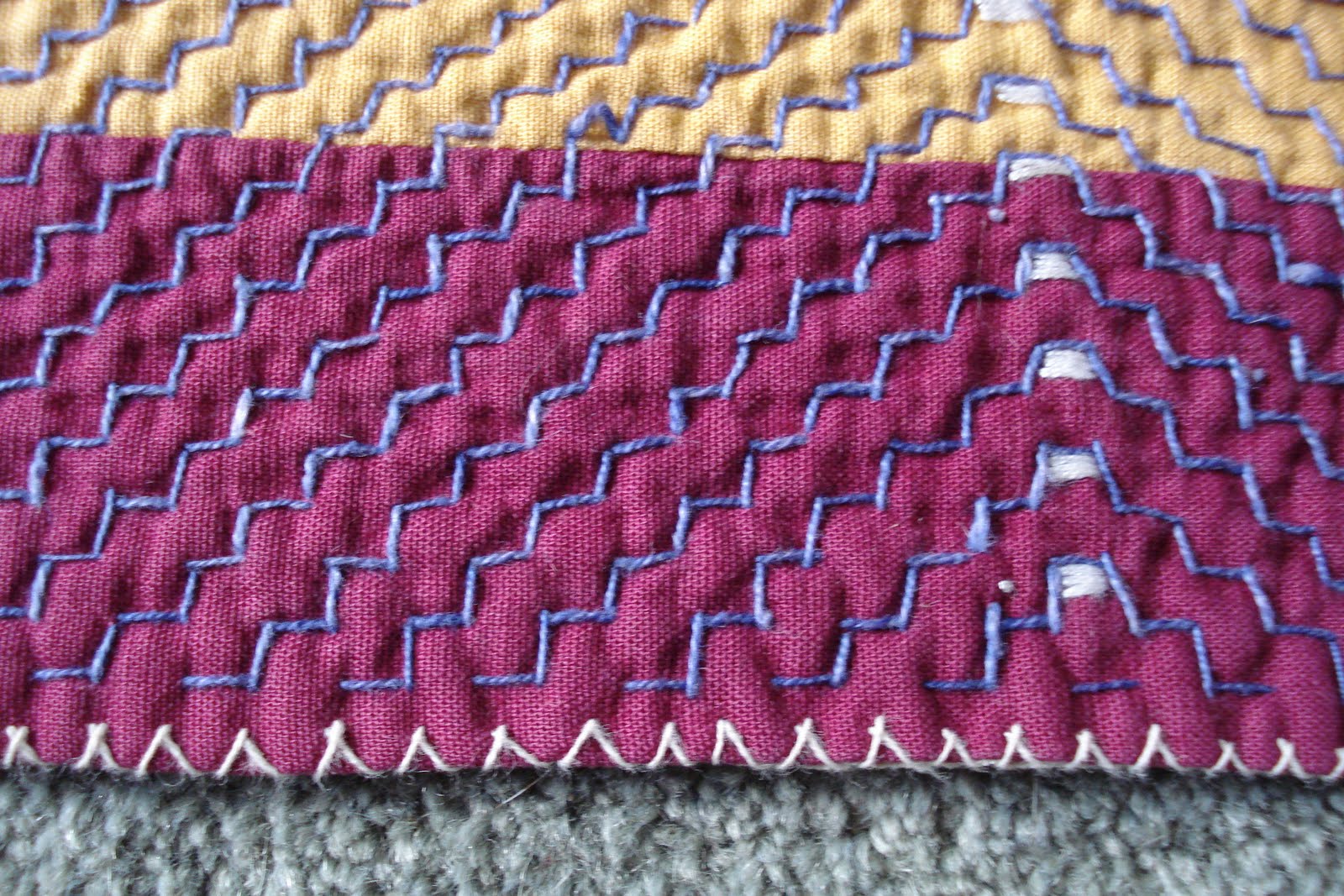


The edge is turned in, and embroidered with a tent stitch.


The reverse of the quilt is in cream cotton.


Reverse of the quilt.Stoddard reports that Jogis are snakecharmers and entertainers, and are found on both sides of the Pakistan-India border. They were traditionally nomadic but have now settled down. The Jogis are well known for their small square rallis used for carrying snakes as well as embroidered quilts.

Thursday, 6 October 2011

Indian Quilts

Recently, I have been reading up on Indian quilts. I have had the book on Ralli Quilts for some time, but recently I bought John Gillow's book on Indian textiles and also Crill's book on the V & A collection of Chintz fabrics. I was able to speak to John at the FOQ. He felt that Rosemary Crill at University of East Anglia in Norwich might be a good person to approach.


As you may remember, I discovered that one of my quilts is the one featured in Plate 49 in Hakes book. John felt that the "Himalayan" of the description would be one of the ten hill towns, and that the quilt was probably the product of missionary work. Apparently there was a magazine at the time for Missionary workers, which could be an interesting archive to look at. Another researcher has also found, in the Rose archives in Farnborough, that this quilt came from Muriel Rose's "Little Shop" in London; also that it was dyed blue in order that it photographed more clearly for the plate in Hake's book. I shall have to follow this lead up as well.


I do have two Ralli quilts, both purchased very inexpensively. This one is made with commercial cottons in bright colours. It measures about 58 x 80 inches. John Gillow states in his book that "they are most probably the influence of British or more likely American female missionaries in the latter part of the nineteenth century. Many of the patterns, such as flying geese, found on Anglo-American quilts are included in Sindhi patchwork quilts."


The edge has a dog tooth edging. The quilting is a straight running stitch. No provenance on this quilt, of course.


Mostly plain cottons but there are one or two prints. The patchwork is a bit hit or miss...the quilt does not lie flat......


...and the quilt is far from square......


I have a second Ralli quilt - this one is a bit more elaborate and in more muted colours...it is a long quilt, and this photo shows just one half of the quilt - the seller said that it was vegetable dyed but somehow I doubt it...


Again, mostly squares and triangles, with some dog tooth edging.


The edge has been repaired in some places and the back is worn - a quilt that has seen use....


The dog tooth edging is applied, simply made by clipping a long strip at regular intervals and then turning under the edges and securing with a stitch or two. The quilt seems to have been much brighter originally and has faded with use and exposure to the light....this does not look like a vegetable red dye to me...


The next quilt history occasion is the seminar at Gregynog at the end of the month - then I will hope to get to the V & A to look at the Hake archive. I was also pleased to see a small collection of Canadian Red Cross Quilts at our local quilt show at the weekend - and surprised to learn that Jackie Maxwell has recently moved to Woodbridge. She is part of the Canadian Red Cross Quilt Research Group.