This is a quilt with a special story. It is a north country strippy quilt dating to the turn of the century, made in turkey red and paisley fabrics. The strips are 7" wide and the quilt measures 82 x 91 inches.
 The quilting is a bit crude but this is a good example of the quilts that were to be found in most households. The quilt was sold by a lady called Carol, on behalf of her 96 year old neighbor Peggy, both living at Stanley near Beamish in County Durham.
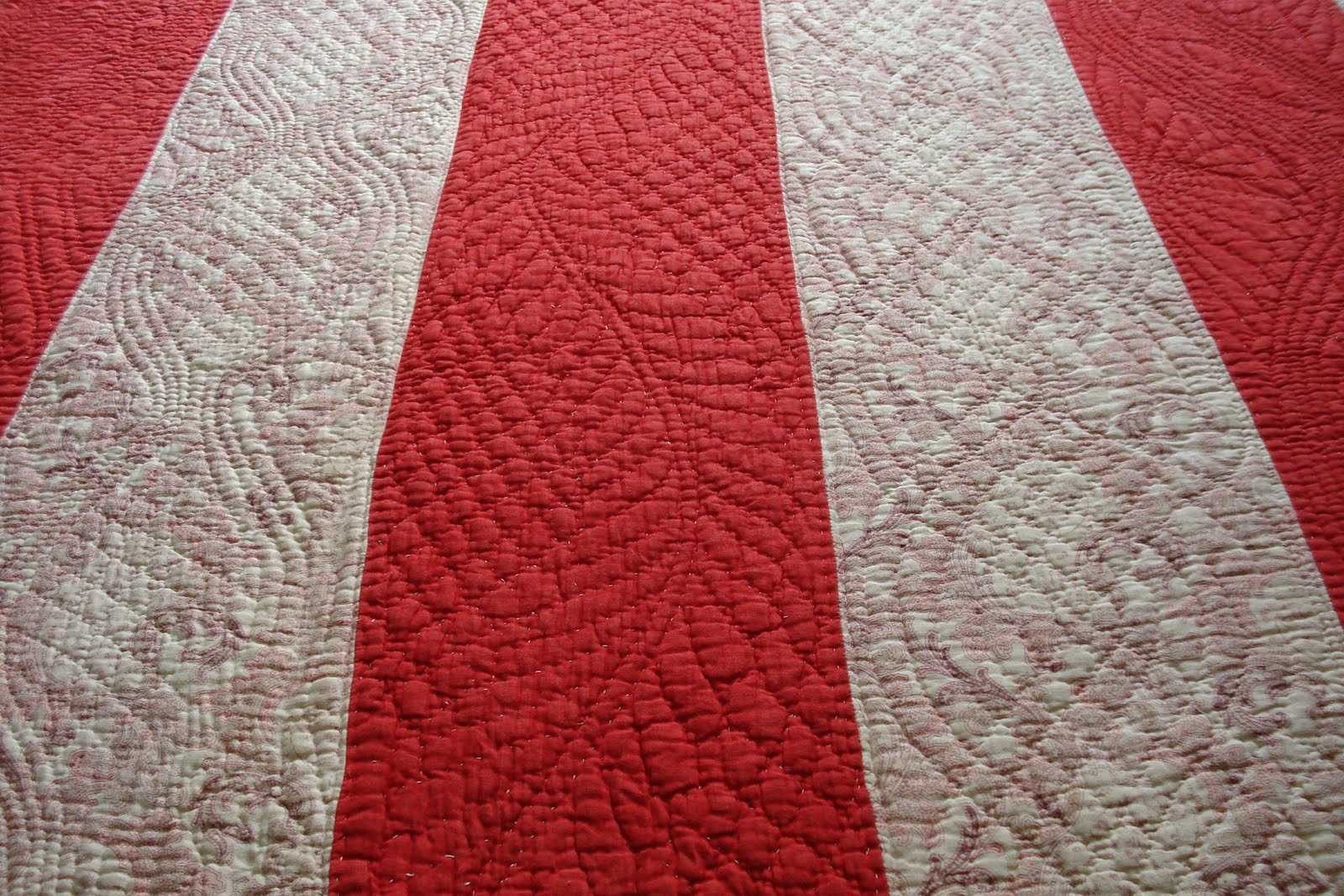 Here you can see running feather, bellows and a twist pattern.
Also to be seen are daisies and a worm pattern.

The reverse is a paisley fabric in a different colourway.
 The edges are very crudely done, even by Durham standards where edges were often an afterthought...
Another very wonky edge - this might be a "club" quilt...
Now Peggy thought that the quilt was made by her grandmother for her mother when she was married. I asked Carol to try and find out more details and received this long email...
"Hello I have some updates on the quilt. The family were called Madden and lived in Beamish. The maiden name of Mrs Madden was Watkins. There were - as far as I can determine - 8 Madden offspring - one of whom was Peggy. It took ages to get to this! When I thought that part was sorted she kept saying there were ten of them including 'poor Peggy' - I can only assume this was an aunt as there surely cannot be two Peggys in the same family. Something dreadful must have happened because in 1919-1920 the whole family were split up - including the baby - whatever it was must have been pretty final because Peggy never really knew her mum and dad. She went to live at No Place - a small mining village about 1 mile away with another branch on the Madden family - she also lived with a family called Morton who had a daughter called Joan - and they lived then at Andrews Houses near Sunniside [RA miners housing - now derelict] - next field to the current Tanfield steam railway. I presume after that she was married because she never (email stops here)
Sorry, cont. I cannot find out much more but in delving into this I have discovered that in some way there is a connection to my family - I never thought along these lines before - I asked my cousin if she knew anything and she told me that another Peggy - a Madden - married my father's brother - so - distant as it may be - but there it is - Peggy has always been around and we love her dearly - it is so sad she is losing her memory - or her marbles as she puts it - and worse she knows it. These snippets of info took lots of laughs and tea and biscuits but it was worth it. I am glad that you asked about the background to the quilt because although the family link is very questionable is it nice to know Peggy is ours properly if you know what I mean. Regards Carol

Another view of the quilting patterns, which follow the strips in the north country tradition. I was very touched by this story and was glad that the quilt had found a good home.