Search This Blog

I am a quilter living in Woodbridge, Suffolk who has made quilts since I was a teenager. I also ring bells! Both are great British traditions....I will try to feature some of my antique Welsh and Durham quilts, the quilts I make myself, my quilting activities and also some of my bellringing achievements. Plus as many photos as I can manage. NB: Double click on the photos to see greater detail, then use back button to return to the main page.


Saturday, 2 April 2016

Two Strippy Quilts - West Aukland

These two strippy quilts came from the same seller in Bishop Aukland, Durham - an area very well known for quilts and quilting. Neither quilt is terribly special in itself, but I still enjoy them. These are typical "club" quilts and were made to be used at home. Subscribers paid one or two shillings a week - about 5 or 10p - until the purchase price was paid. The cost of a quilt was too much to be paid in one fell swoop, so the subscription helped support a quilter and her family and also allowed the cost of the quilt to be spread over many weeks. A lottery decided who would receive their finished quilt in a particular week.


I should tell you that neither of these quilts was very expensive - both cost about £30 pounds each - about $50? When one considers the cost of todays fabrics, and also the cost of one's time to make and quilt such an item, this seems like a small price for something approaching 100 years of age.

This quilt is the more colourful, but more worn of the two. The online listing showed a photo with lurid colours - slate and purple - that I knew were unlikely to be real. It turned out to be a typical pink and white on the reverse and pink and cheddar orange on the front.


The other quilt was described as blue and cream, but is actually a blue green colour with yellow stripes. The reverse is solid blue green. This quilt is in better shape than the other quilt.


Typical patterns are seen daisies, twist and a flower in a square, all border patterns.


The orange and pink quilt has a running feather and an orange peel design.


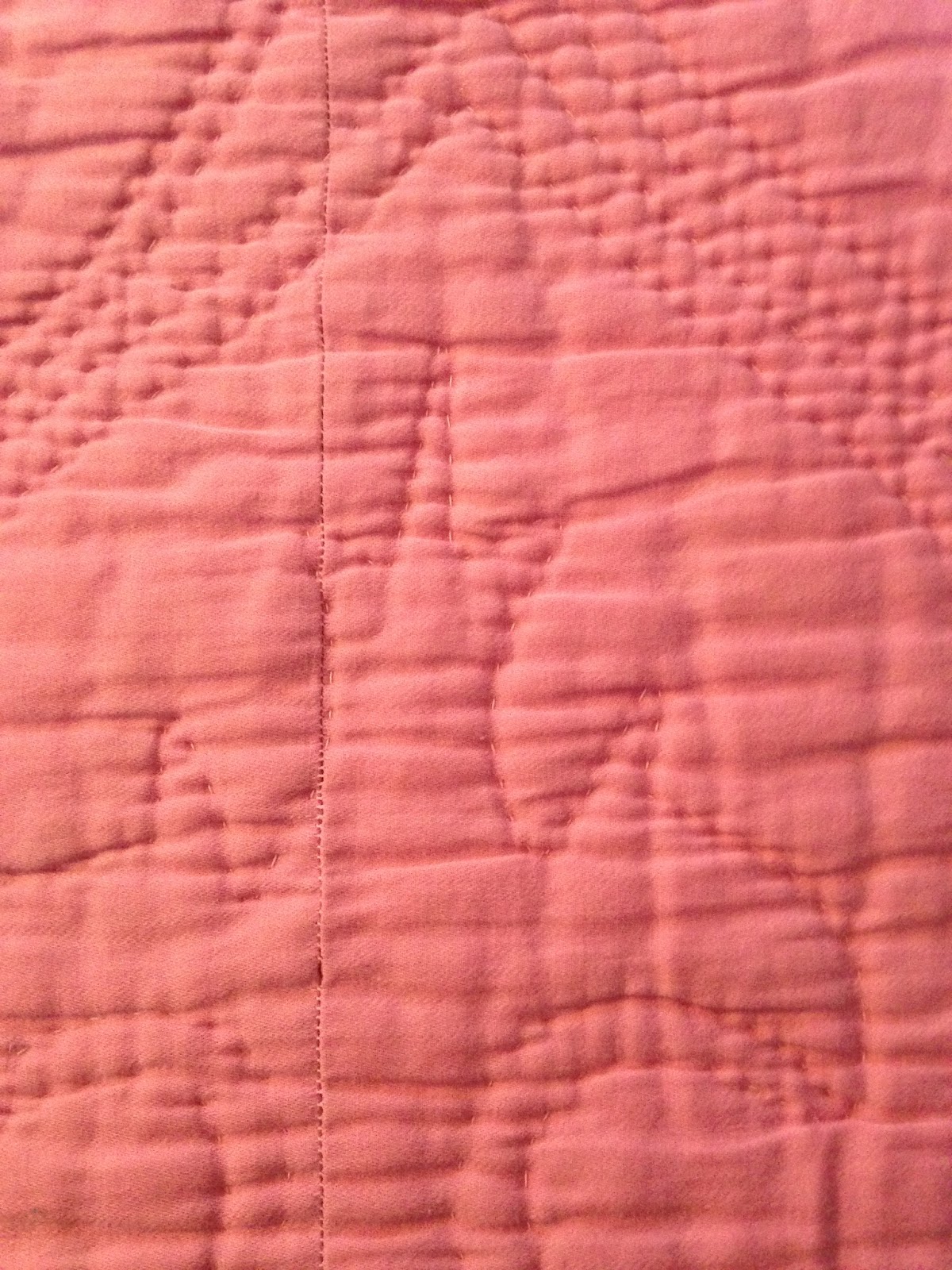
You can see that the fabric here, especially the orange cloth, is very worn. There is also an obvious spot - perhaps of bleach or cologne that has caused colour loss.


But I like the fact that these quilts have been used and were once important possessions....


 These quilts were made rather quickly (in about a week or two) in a frame. Patterns had to be easy to mark and not so intricate - simple enough to cover the fabric effectively and yet look good. I think this was certainly achieved!
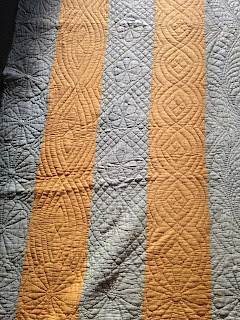

 These quilts both came from the same house clearance, a great aunt of the seller who lived in the mining village of Evenwood, where she was born in 1904. The mother of this great aunt came from the neighbouring village of West Aukland, and the seller thinks that these quilts might have come from there. The seller thought that these might have been made by the mother, but it is equally likely that they were made by a local quilter, of whom there would have been several.


You can see that the quilting is better in this quilt, perhaps because it has suffered less wear?


 The reverse of the quilt is plain. The size of this quilt is 78 x 95. The stripes would have run up and down the bed, not across.....the cloth is, of course, cotton sateen which has worn well and is very soft to the touch. I wonder if our modern and more expensive fabrics will wear as well - probably not....


Saturday, 26 March 2016

Pink Hawick Quilt

I have long been interested in the Hawick quilts, after seeing examples and then reading Linda Lane's article on them in Vol 9 of Quilt Studies. So when I saw another on a auction site at a very reasonable price, I had to have it! This one has the tell-tale " spiked hearts". It is in pink cotton sateen on both sides. 


You can see that the sizeable outer border is a double row of spiked hearts. Then, a simple twist, with the centre being filled with swags - usually a border pattern! There is some infill to complete the design...


But no thistles, gowans, yin yan or scale patterns...which are other templates commonly used on these quilts...


Three of my other quilts have "the edge" whereby the top and bottom sheets are seamed together before putting into the frame. One of the quilts is rather worn and it is hard to tell.....this quilt also seems to have the edge, although it is not so obvious...


These quilts were made by church groups in Hawick, to raise funds, initially to replace a church that had had a serious fire. Annual sales were held, evidently it took some time to make enough goods to sell..


Can you see the edge that looks different to the bottom? I think this might be "the edge".


The spiked heart...quilting not the greatest (as one would expect from a group quilt where not everyone was a expert, and the sewers wanted to make speedy progress....)


An odd seam, where the sewing machine tension seems to have gone a bit mad....


There is just one slight stain on the quilt.....these quilts were made in the 1920's....so not bad for a quilt almost 100 years old....


My other quilts did not have the swag pattern.....but here is Barbara Chainey's Hawick quilt, and you can see the same swag template used in a different manner....only single hearts, a double swag border and then the four heart centre.

After my bad experiences with My Hermes ( one Hawick quilt delivered to the wrong address, and small item sent to Inverness not Ipswich and never recovered) I insisted that I pay extra for Royal Mail. The last Hermes  parcel I had was left sitting next to the front door...when I arrived home, the box with this quilt was sitting next to the back door...I guess that's what an extra £15 gets you these days!

Just out of interest, I went upstairs and measured the other Hawick quilts. This one is 64 x 78 inches. The others were all the same size, within an inch or two. It seems that the group had a trusted method of making up the two sides, but varied the patterns within their repertoire of templates.

This quilt was given to the seller in 1996 by her mother, with two other stamped Allendale quilts, both rather worn...no other information available.....

Sunday, 20 March 2016

Shirting Quilt from Carnforth, Cumbria


A recent arrival....a utility quilt made in 1912 with a variety of shirting fabrics. The fabrics are reused and wonderfully soft. Many of the patches are cleverly pieced from smaller fragments of clothes....a variety of colours and patterns are seen.


The quilt has no wadding but is quilted in white thread.


The centre is a large nine patch....


The backing is recycled flour sacks. The sewing is a mixture of hand sewing and machine, with most of the piecing being done by machine.


Here you can see the clamshell quilting pattern, which I think must be a Borders pattern as it is also seen in the Hawick quilts. There is also a simple twist near the edge.


More patterns, checks and stripes....


This quilt came from Thwaite Gate Farm in Carnforth and had been passed down in the family. Great Grandfather was named William Henry Stephenson. I just love the connection with the Lake District!

Thursday, 3 March 2016

Pink and Cream North Country Wholecloth Frame Quilt

I must admit to have been wanting a wholecloth frame quilt for some time. Many have very attractive borders of printed floral fabric and look very decorative as wholecloths.


This quilt has a border of plain fabric, nicely mitred in each corner. The colours are reversed on either side - pink borders on one side and cream borders on the other. the quilting is especially nice and well done - a feature of earlier quilts. Later quilts tend to have larger stitches and simpler designs.


The frame makes an attractive quilt, although simple in format......


The quilting has many double and triple lines - the stitches are certainly made by an experienced quilter, probably a professional seamtress or quilter.


the corners are handled well, with a daisy and paired plumes.


In the borders are swags - triple lined - with spectacles. Stars and diamonds complete the design.


A photo to show how the colours reverse on the two sides of the quilt.

This quilt was bought at auction in Derbyshire and no information is known about it. Some of the other items had Duffield written on them.

Lilian Hedley says that this style was popular from about 1900 until the First World War. The size is 78 x 84 inches and it is made of cotton sateen. Again, a bit mystifying as to price as, although in the popular colours of pink and white, it went for only £75.....very reasonable for such good quilting. Perhaps the fact that it was sold as a "Comfy Quilt" has something to do with this? Comfy quilts were machine made and although attractive, being factory made in colours that are not always to modern tastes, are not very popular.

Wednesday, 10 February 2016

Fabric of India - V & A

Before Christmas, I was able to spend two hours at this exhibition at the V & A Museum in London. The V & A has a huge collection of Indian textiles, which had never had an exhibition solely dedicated to them before. I had not realised that there used to be a Museum of India in London.....upon closure, many of its items came to the V& A. The museum also possesses many items from the Great Exhibition held at Crystal Palace in 1851. A type of trade fair, all parts of the Empire sent in items of trade and technology. Many of the Indian exhibits related to textiles and fabric and still contain details of their supplier and manufacture.


Here is the catalogue for the exhibition - a sizeable book which is lavishly illustrated, nicely written by Rosemary Crill.
The contents are: Introduction, Materials and Making, Patronage and Use, and Textiles in the Modern World.


The chintzes that we are familiar with were relegated to a small display towards the end of the exhibition  - a testimony to the great importance and marketing of these textiles, of which Europe was only one part.


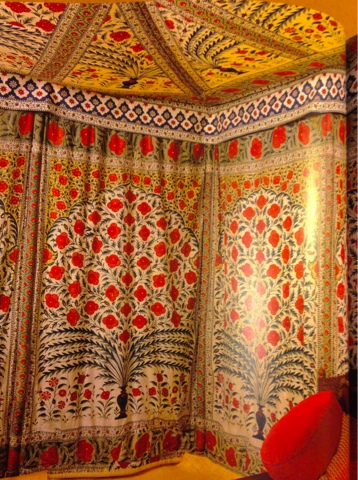
Many of the exhibits were stunning wall hangings or floor coverings. The designs were adapted to the customer's or regional tastes. This is part of a hanging, possibly a floor covering.


One of the most fascinating displays was the set of hangings now kept at Powis Castle - the Tent of Tipu Sultan of Mysore, Mughal India, c 1725-1750. Cotton, block printed, mordant dyed and resist dyed. The tent was part of Tipu relics removed by the British in 1799 and then taken by Lord Clive. Powis Castle is now owned by the National Trust.

I also enjoyed a tent with applique arranged in a smaller side room. Apparently it had been found abandoned on  a New York sidewalk!

There was much to look at, and I'm sure that I could have spent much more than two hours - if I had the time or the stamina!

Monday, 4 January 2016

What I did over the holidays...


I'm still working.....so I value my holidays, as I am able to make progress on some of my projects.
I most enjoy hand appliqué and hand quilting, so my projects usually reflect this...

I have been slowly working away at the appliqué of my Silversword Hawaiian quilt top, for a short time most evenings.  I'm about one half the way through the border, but of course there is the very large centre to complete as well. Not so easy to grapple with as the outer borders!

For this top, I am outlining with a white Sewline pencil, and needle turning to this line. I am using Aurifil 50 in a dark green, which is proving very nice to use.


Part of the border...I redrafted it so that there was more reverse appliqué....


...so that the design looked more like this illustration. The pattern is from the 1980's, and the illustration is pretty poor....not much like the actual pattern in the arched leaves...makes me realise how far computer generated images have come along.....


You might be able to see more of the pattern and the centre, here....


I was also able to start quilting my previous Hawaiian top, Lei Momi or Lei of Pearls. Red and white is a favourite colourway for me, so cheerful.


It was quite a job to baste it....I had to wash and piece the backing, iron the top and then pin baste the whole. Of course, although "quicker" to do it this way, rather than thread basting, I have to be more careful when putting it into the frame, not to pull any if the safety pins. I often have to remove some pins so that the caps do not pull them. I am using wool wadding, which is a standard now unless I am making a utility quilt.


I also spent two days machine piecing this Sanderson Star....shown above, not pressed yet. It would have been easier in some respects to hand piece, but as the stamped top was machine pieced, I felt that I had to follow this example. I did not follow a commercial or published pattern, but traced each star piece from the quilt top onto freezer paper and used these as individual patterns. Even so, I may have to tweek some of the setting pieces. It certainly is not a simple pattern, it has 15 inset corners....and very odd shaped setting pieces. For example, the corners are not squares, they are rhombuses.....It certainly gives me a lot of respect for those old time Allendale quilters and their abilities!


I'll have to add the red and white borders, something I HOPE will be easier than piecing the centre, and then transfer my tracings of the stamped quilting designs to the top. The quilt is about 98" square. 

Monday, 7 December 2015

Irish Strippy quilts


I have four quilts that are Irish - three are shown here. I have previously shown another Irish quilt which was made of shirting materials.


This quilt is a lavender and white strippy - it is made of offcuts of fabric, probably linen, and is unlined.
It measures 70 x 80 inches.


The quilting is a simple grid done on the machine.


Two other quilts are similar. The green and white quilt is 80 inches square, while the yellow and white quilt measures 60 x 72 ". Again, I think these two quilts are made of linen offcuts, or a mixture of linen and cotton fabrics.


All three quilts came from the same seller in Suffolk. His mother in law had lived in Ireland and had a stunning collection of quilts . These quilts were bought from a well known dealer (  but he could not remember the name).

The folowing information on Irish quilts  comes from Rosalind Shaw:

Traditionally, Irish quilts consist of two layers - the top and the backing stitched together. They could not afford to line the quilts with wool, which would have been needed for other purposes.

Some linen merchants had a day in the week when they sold pieces of linen to their workers, for the purpose of making patchwork quilts. These linen pieces were often made into frame quilts that were very fashionable in Northern Ireland.

Belfast and Londonderry had many shirt making factories; many shirt scraps were available. The workers made the patchworks in their spare time and sold them.

The quilts were referred to as Derry quilts, Shirt quilts, and  Belfast patchwork. Quilts seem to have been labelled according to their source and materials, rather than the patterns.