Search This Blog

I am a quilter living in Woodbridge, Suffolk who has made quilts since I was a teenager. I also ring bells! Both are great British traditions....I will try to feature some of my antique Welsh and Durham quilts, the quilts I make myself, my quilting activities and also some of my bellringing achievements. Plus as many photos as I can manage. NB: Double click on the photos to see greater detail, then use back button to return to the main page.


Tuesday, 21 June 2011

White Allendale with Star Centre

A white Allendale quilt which was stamped with a large star pattern enclosing the central design.

This quilt came from a house clearance on Tyneside, so no real provenance. It is worn along the sides, but has some nice stitching to see. The size is a double bed size, 78 x 90 inches. The earlier quilts were square but gradually the quilts became rectangular in size.


This quilt is white on both sides, but one side may have originally been light blue as one side has a definate blueish cast.


The central dedign has a central rose surrounded by flat iron motifs, the whole surrounded by two triple lined squares forming a star effect.

The quilt is rather worn and the cotton sateen has gone very soft; the edges are worn.


The border is a typical swag border, with trefoils at the junction of the swags.The diamond infill is neatly quilted.


Another view of the swag border and the triple lined star of the centre.


One interesting detail on this quilt is that it has "the edge" as set out by Pauline Adams, whereby one edge was seamed together ( ie back and front sewn together along one end) before the quilt was set into the frame. This edge does look different than the other three (as it lacks the neat hand stitiching of the other three) , and you can see that along this side the wadding does not reach the edge of the quilt as it does on the other sides. Although not recorded in the literature, this must have been a widespread technique as I have found it on several of my quilts. There is a fuller explanation of this edge treatment in my "Hawick Quilt" post of 27 April 2010.

Sunday, 19 June 2011

Pink and Yellow Teesdale Quilt

Here is a nice Allendale type quilt in pink and yellow. This quilt came from a farmhouse clearance in the Cotherstone area of Teesdale. It perhaps was locally marked as the dealer has seen other similar quilts in an exhibition in nearby Middleton several years ago. The family knew nothing of its history, it was just in a cupboard. Size is 82 x 91 inches. The stitches are very neat and there is a line of machine stitching around the edge.

There were professional quilt markers in many villages; Allendale was the best known but there were other areas with their own local traditions. Quilters speak of Allendale quilts, Weardale quilts, Teesdale quilts and so on - local quilters did have their own repertoire of patterns that they used.


The central design shows a central rose or flower surrounded by flat irons filled with a stem rose motif. There is a large feather motif with a smaller outer running feather.


A better photo of the central area - I like the chevron infill that creates a strong star effect between the flat irons. Triple lines of stitching create a double outline to the flat irons - very effective. You can also see the outer feather infill.


The background diamond infill is neatly marked and stitched. The lined swag or hammock border has a rose atop each join and there is feather and curlicue/scroll infill beneath. There is a corner device of a larger rose plus a feather with scroll work which points towards the central medallion. The curved petals of the roses make me think that this is perhaps a bit later in date than some of the other stamped quilts.


The front is a rather faded and gentle pink cotton sateen, the reverse is a bright yellow fabric. This yellow is very strong and rather acidic in colour, being of a slightly greenish tint. Yellow and pink was a favourite colour combination in north country quilts.


The edge of the quilt with its double line of machine stitching.


A good example of a "stamped " quilt. You could either send your own fabric off to be marked, or you could buy tops ready marked. Professional quilters also marked and made fancy quilts for local people. It is hard to know what type of quilt this is, but its a nice example.

Saturday, 18 June 2011

Goose Wing Border

When I looked again at the last post with the navy Allendale from Ayr, I realised that I had not posted a clear photo of the goose wing border - so here is another photo.

You can see that the goose wings do make a lovely, sinuous border. The central vein makes a nice distinct curved line. There is floral infill below, and a proud feather motif above.

I will have another stamped quilt tomorrow, this time from the Teesdale area.

Wednesday, 15 June 2011

Navy Allendale - Ayr

Here is an Allendale quilt which came from an auction in Ayr, Scotland. Marked tops from Allendale were sent to all parts of Britain, including Scotland and Wales. The quilt is a double bed size, at 80 x 93 inches.


This quilt did not cost me much as it has been dyed navy at some point. Quilts were expensive items, and if they got stained they were thrown in the dye pot to disguise this - they certainly were not thrown away. No "throw away society" then! You can see that the colour is uneven and you can see the stain in parts. There is also a big "bite" out of the edge on one side...


The centre of the quilt is a lovely star motif -There is a central rose surrounded by diamonds - the diamonds have the traditional rose and fern as quilting patterns enclosed in them. There are also large feather motifs. Stars were a popular motif - both as a central quilting design and as the Sanderson Star,a patchwork pattern.


The edge treatment is nice - goose wings with a large corner leaf motif. A goose wing is a curved, one sided feather. It looks good in pairs, or as here, end to end as a graceful border. Swags and goose wings are the most common borders in Allendale quilts.


Another look at the large feather motif - you can see that the stitching is of a good quality on this quilt. What colour would it have been originally? White or another light colour?


A view of the edge of the quilt, showing the single line of machine stitching around the edge. This is a quilt which demonstrates some of the other major quilting designs marked by the Allendale quilt stampers.

Tuesday, 14 June 2011

Further Progress

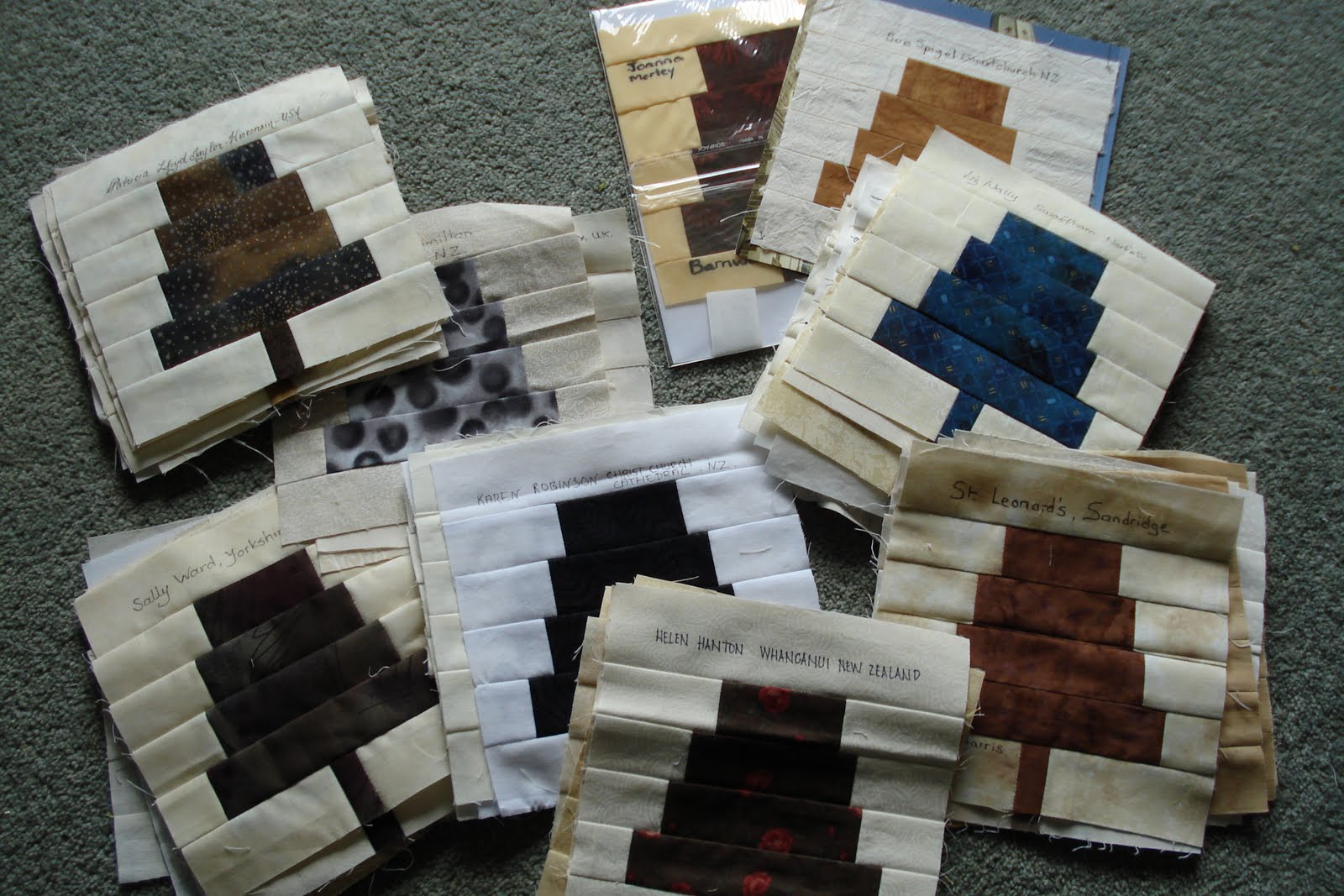
Just to show you the blocks I have had in so far ....over 50 with more promised as a result of the Ringing World article. Too many to list here - but I am keeping a careful list of all that are received. I have enjoyed reading the notes that come with them!

I think that we will have a good sized quilt - I will soon start sewing the blocks together, once I have decided how big the central panel will be. I am going to make a 6 inch template and lightly mark that on the reverse of each block - this should make sewing them together easier. And, I am still pondering a way to put some writing on the quilt - it would be nice to hve Christchurch Cathedral 2011 on it , perhaps towards the bottom of the quilt...still pondering....will post photos when I have decided...


I was pleased to see that my Hawaiian red and white quilt was featured in Fabrications magazine. An easy choice as wholecloths are notoriously difficult to photograph and are not as colourful. It was a nice touch that Grosvenor Exhibitions sent me a free copy, although I had already bought a copy.


Saturday, 11 June 2011

White Allendale

Another quilt which appears grey in the photo but which is in fact a lovely white quilt. This quilt was only bought recently - what attracted me to this quilt was the fact that it has very similar quilting designs to the light blue Allendale quilt. While that quilt was in poor condition, this quilt is in unused condition. It still has the sizing in the fabric and clearly was never used.

The size is 81 x 96 inches, for a double bed and rectangular in size.


The design is clearly a stamped design, and is very similar to that on the Blue Allendale and also the two examples shown in the Beamish book, Quilts and Coverlets. All clearly by the same hand, the little hand marked feathers are so distinctive. There is one mark on the quilt, which you can see in this photo but otherwise in very good condition. Date is about 1900-1910.


The swag border is slightly different - not a fleur de lys but a circle with three feathers poking out as a corner device - also notice that the swags have trefoils not roses.


Central area very similar - except - can you see that surrounding the central rose, there is a circle of straight feathers or ferns. I find it difficult to tell the difference between these two patterns - Lilian says that in feathers the lines and ends are curved whereas in leaves the lines are straight and the ends pointed. The stitching in this quilt is very neat and well done. As was common, there are two lines of machine stitching around the edge of the quilt.


Another look at the corner design. What I cannot understand is that there is no blue pencil to be seen on this quilt. Some of the older quilts have been intensively used and washed and yet traces of blue pencil still remain. However here, with the quilt is pristine condition, there is no trace to be seen. Was there a special way to wash the quilt to get rid of the markings? Were a variety of different pencils used? I don't know!!


Detail of the pierced ferns which are typical of Allendale quilts. You can also see the ring of straight feathers/ferns surrounding the central rose.


The 3/4 inch diamond infill is well marked and well stitched and looks very elegant. This quilt in white would have been a "best" quilt.


Corner of the quilt - corner rose plus the machine stitching on the knife edge to create a firm edge to the quilt. Post war, the Womens' Institute had exhibitions where any quilts with this treatment were disqualified - the WI only approved of hand stitched edges - and yet it was a widely used technique.


No provenance for this quilt. It came from a large collection of quilts where no information was recorded.

Wednesday, 8 June 2011

New Pink Allendale

Having traced the patterns from the old quilt, I decided that it would be fun to recreate the quilt and make a new one. It is always hard to find suitable, high quality fabrics for wholecloth quilts, but I had a top in pink polished cotton from Strawberry Fayre left over from my week with Lilian Hedley at Sedbergh.

I had devised a light table from four wrapped bricks and a large sheet of perspex with a fluorescent light below. Turning the polythene over so that none of the Sharpie ink could transfer to the fabric, and securing the fabric with pins, I was able to trace the markings on to the fabric with a mechanical pencil. Of course, I had to use a very light hand. A problem was that the old quilt had shrunk and did not fit my exact rectangle on the new top- so some cutting out and rearranging of the border elements was required. Another problem was the 3/4 inch grid - I tried and failed, twice, to hand draft a pattern - the errors quickly magnified. Eventually I printed out a 3/4"grid from the computer and taped many A4 sheets together until I had a large enough piece - I then reoriented it to be diamonds - trimmed - and used this to trace the infill. Although the paper pattern wasn't as sturdy, this worked really well and the diamonds all joined up perfectly at the four quarters. It took me a whole Bank Holiday weekend (three days) to transfer the markings onto the top - so I am filled with admiration for the professional quilt stampers who were said to be able to mark one or two tops per day with their helpers.


I used wool wadding which gives a better appearance with hand quilting but of course the original quilt had a cotton wadding. Here I am at the quilting frame - it is a Q-Snap which I find good to work at. I am already on number 2 - they don't last forever, the outer clamps eventually crack as the whole is made of plastic.


The centre of the quilt with its central rose, pierced ferns and pomegranate type motif.


Corner of the quilt where you can see the fleur de lys, swags and curlicue infill. The edge is the traditional knife edge where the edges are turned in - NO binding on British quilts!!


Another photo of the centre and corner designs of the quilt.


This is the stall at the 2010 Festival of Quilts where I was able to display the old and new quilts. I really enjoyed this.


I have more old quilts in this style to show you.