Search This Blog

I am a quilter living in Woodbridge, Suffolk who has made quilts since I was a teenager. I also ring bells! Both are great British traditions....I will try to feature some of my antique Welsh and Durham quilts, the quilts I make myself, my quilting activities and also some of my bellringing achievements. Plus as many photos as I can manage. NB: Double click on the photos to see greater detail, then use back button to return to the main page.


Monday, 30 July 2018

Summer Holiday in the Yorkshire Dales 2

For our second walk, we ventured into Swaledale proper, and walked from the village of Keld, to another village, Muker. Tin mining took place here in the past; it must have looked quite different then, and been much more heavily populated.


This barn is noteworthy as it has a stone lintel dating to the late 1600s. A mystery, as most of these barns were built in the mid 1700s - perhaps the lintel was reused?
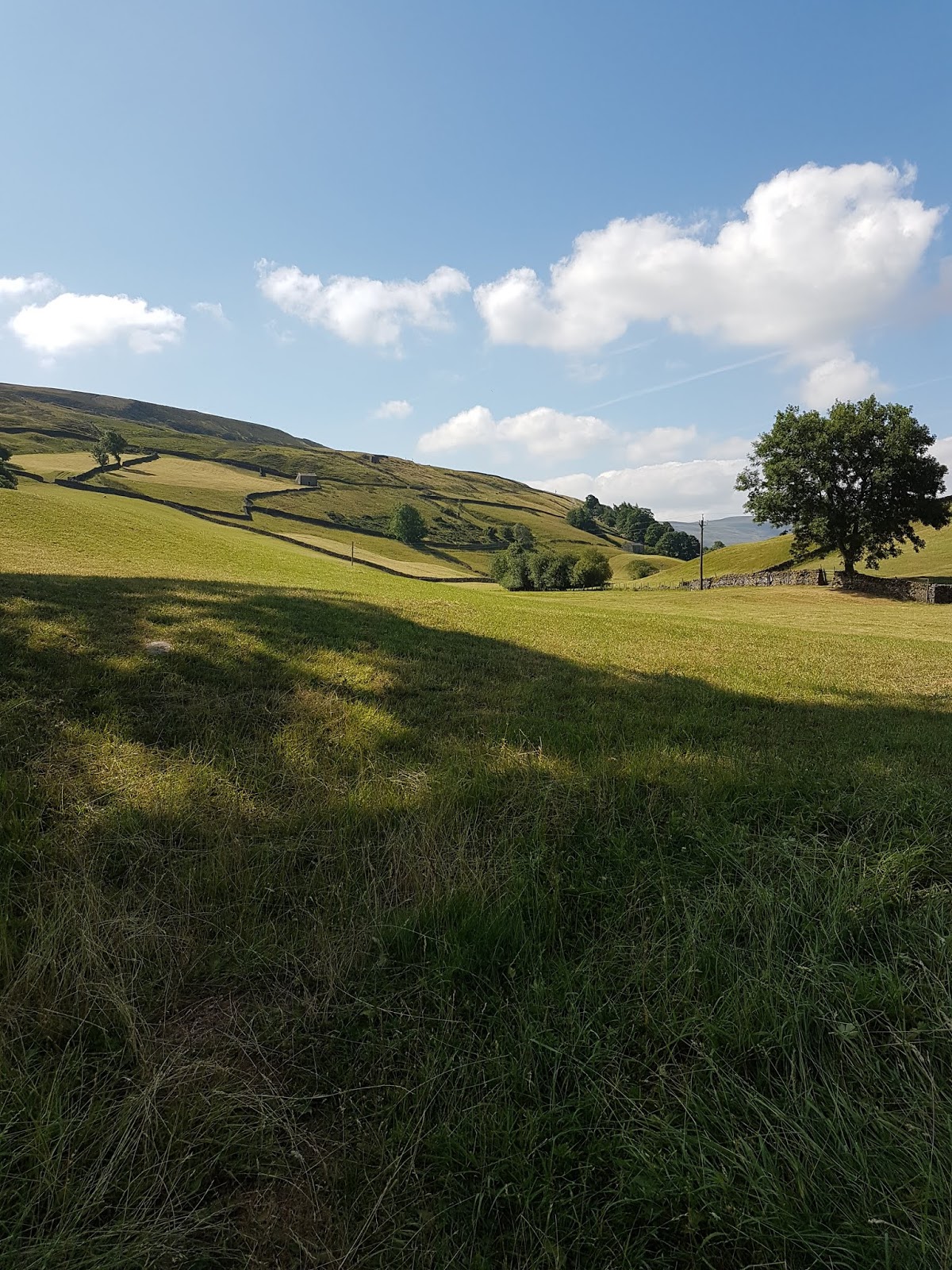

The weather was fine - very hot and sunny.


The first part of the walk was the steep bit - the valley opened out before us.

This was the famous "corpse path" - the local churches did not have graveyards, and bodies had to be taken down the valley to the church at Grinton to be buried. The path was steep and narrow, and the journey took 2 or 3 days. Eventually, the smaller churches got their own graveyards...


The valley, with a very low River Swale at the bottom...

More fingerposts...


The track as it approaches Muker....we had lunch and a drink at the Farmers Arms there...


Then, back up the other side of the valley, a gentler and more level walk.


More stone barns. These protected stock from harsh winter weather. Many animals were slaughtered in autumn, and the animals to be kept on were fed on stored feed throughout the long winter. Barns in each field ensured that the animals did not have to be moved any great distance.


Another fine stone barn...

The Swale, looking very low...

Former mine workings. The water did not have much life to it, and we wondered whether the toxic minerals leached into the water...


Another view along the valley...
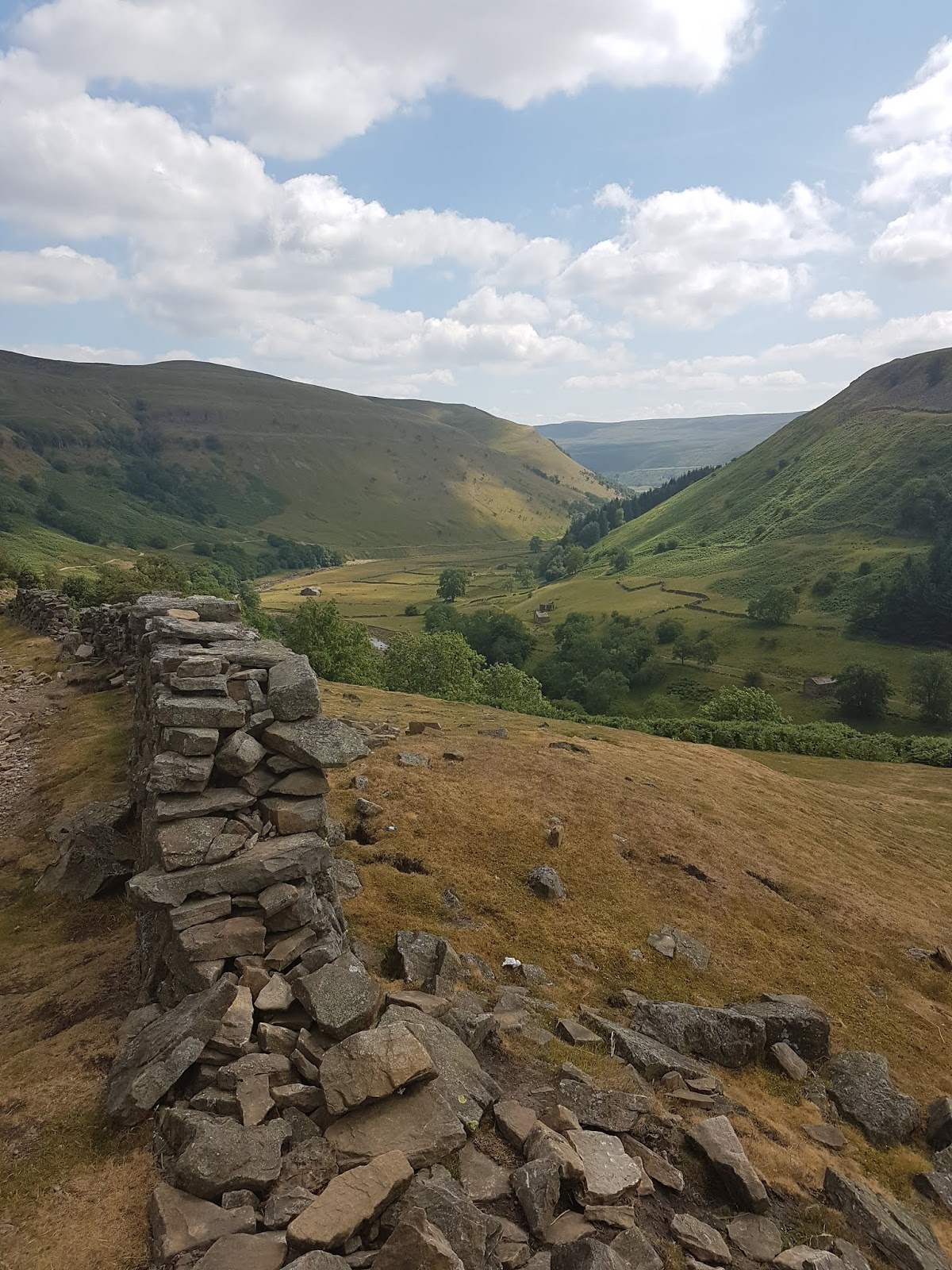

Stone walls must have required much labour to build....


On a hot day, it was fun to swim in the river....


Later, we set out for Sedburgh (where I once took a wholecloth course with Lilian Hedley. And site of the famous kicking incident at the local bellringing practice!) A local music day was taking place.


We also went in search of the famous Ribblehead viaduct. On our visit at Easter, we went on the Settle line, but of course when on the train, one cannot see the viaduct! A drone buzzed overhead, as another group made videos of a train departing the station.

Wednesday, 25 July 2018

Summer Holiday in the Yorkshire Dales 1

 
Having gone to the Dales over Easter, I made plans to return again in July. We had a light snow at Easter - but in the midst of a drought, the countryside looked very dry this time around.
 

We drove up on a Thursday evening and managed to take a quick walk around Hawes after some dinner....

On Friday, I planned a walk from Aysgarth Falls to Bolton Castle and back. I had spotted the castle driving along the road the previous day, and wanted to investigate further...The falls were very low, this is the upper falls with Mike trying to take photos.


The day was overcast and there was a bit of rain, but not enough to do any good.


Most of the footpaths are clearly marked by finger posts in the Dales.

 
A few hardy wildfowers, such as this geranium, were to be seen.
 

Just as it started to rain in ernest, we reached Bolton Castle.

This was not only a stronghold, but a family home until a more modern house was built in the 1760s.


We had tea and cakes, then explored the castle, which is partly in ruins and partly restored. Mary Queen of Scots was held here for some months until she was moved to a more southerly location. Of course she was accompanied by a retinue of some 51 persons.


We walked back towards Aysgarth Falls....


The fields were dry, with harvest having taken place..

The lower falls at Aysgarth...


And the middle Falls.....must be very spectacular when there is more water about or after a rainfall.


These falls have been a tourist attraction for many years, and the painterTurner is known to have visited and painted a scene...much less trees then, and fishing allowed...

 
We then visited Aysgarth Church - a wedding rehersal was taking place as we left...
 

In the evening, we made a short walk to Askrigg Falls....very much reduced I'm afraid...

Sunday, 17 June 2018

Red Paisley Shawl ex Sothebys and Castle Howard Costume Gallery

As you may have noticed, I recently became very interested in Shawls.....There are not very many books on the subject, although I have tried to glean as much as possible from the few that I have been able to find.

Here is a lovely shawl with an interesting provenance. This is an earlier, printed example from the 1830s. As artificial colours had not been discovered, the dyes are all of vegetable origin.
The size is large at 80 x 100 cm.


There is some fading, but no repairs. There is a white fringe on all four sides.


This shawl was packed away for decades...


The seller was dispersing her mother's collection of textiles - her mother was a well known interior designer of the 1980s and 90s. This piece was bought at an auction at Sotheby's in October 2003.


The item has a small tag attached...


The interesting part is that the Sotheby's sale was selling off the Castle Howard costume collection.
Castle Howard is well known as the location where "Brideshead Revisited" was filmed.


I was able to go online and find a copy of the sales catalogue - I was surprised when it arrived, as it had come from a large warehouse in India!


Unfortunately, the lot entry for this shawl is not illustrated and does not give any detail - just " a group of five paisley shawls and a stole, circa 1830-1840, with attractive vegetable designs. Lot estimate £300-500 E430-720."

The catalogue gives information on the collection and the reason for its dispersal. The collection was started by George Howard, Lord Howard of Henderskelfe. Instead of in cases, as was usual for the time, the costumes were displayed on mannequins and in room settings. The collection grew through donations, loans, purchases and the family clothes. In 1973 a halt was made to further additions. The collection ultimately had about 25,000 items. By the 1980's the building in which the costume gallery was displayed, the stables, had started to deteriorate, and the cost of upkeep was great. There were worries about maintaining the condition of the displays. The only route to secure the items for the future was to close the gallery and to put the items into storage. Unfortunately, other institutions were not interested in the collection and no suitable  alternative venue could be found. The costume gallery was finally closed in 1993. Meanwhile, the main house needed reroofing. There was also major restoration needed to the garden and its follies.  The interior furnishings of the house also needed constant attention and restoration, hence the decision to sell off the costume collection and raise much needed funds.

It is interesting to look through the varied items in the catalogue. I am glad to have a small item form this sale!

Sunday, 10 June 2018

June 2018

I was very pleased to hear that my red and white Hawaiian quit, Lei Momi, had won the Best Hand Applique at the Malvern Quilt Show 2018.


The quilt arrived back safely, with a ribbon attached. However, in the past, there was a small cup which had to be returned after a year. No sign of this, this year! Perhaps it has been lost?

With my first red and white quilt, Molokama, I won these two in 2011 - Best hand Quilting and also Best Hand Applique. And again, for my purple and cream quilt, Piilani, I won Best Hand Applique in 2013. So it is nice to revisit this. However, no trophy??

Wednesday, 23 May 2018

Recent Progress on Quilts

Just a short report on recent progress with the quilts....the Sanderson Star is mostly finished, with only the knife edge binding and the sleeve left to do. Doubtless that will get done before the FOQ in August!
 

A photo of the quilt....it's a fairly big quilt.

 
I did finish the centre of the quilt - I had not marked it earlier as I was undecided as to what to put there. In the end, I went with something simpler by omitting some of the outlining seen in the original. I think that it looks more dramatic this way.
 
 
Work on the knife edge - with all those layers of fabric, it is rather hard going to make small stitches.
 

I am making good progress with Kikui Nut, the green and white top. It has gone, in its blue Ikea bag, to several bellringing striking contests, where there is, inevitably, a lot of sitting around.The batik is easy to work with and turn under.

I have also started quilting the red and white Hawaiian, Ipu Kukui. I am using a wool/poly blend and I don't think that I will ever use this again, it is not nice to needle in the way that pure wool is. So, a false economy there!

I had some good news this past week. I sent Lei Momi (String of Pearls) off to Malvern, where it won the Best Hand Applique award. I will show photos in my next post.

I was out and about in May. I went to Chigwell to give a talk to the Roding Quilters. Then, to a Regional Day in Sevenoaks for another talk. A nice stay with quilter Sarah A. and fortunately no traffic holdups on the M25! Finally, a talk to a group in nearby Brantham. All the talks seemed to be enjoyed and I had a good time showing my various quilts. Now, no more talks until September, although there is the Traditonal Quilt Group retreat at Grantham the last week of June. I will not be taking a workshop, but will take my own hand applique and be a room helper to Shirley Bloomfield's class. The other tutors are Lynne Edwards and Carolyn Gibbs. As group treasurer, there has been a fair amount of work to organise this event.

Monday, 23 April 2018

A Walk to Semer Water; Bedale

On our final morning, we went for a walk around Semmer Water, one of only two natural lakes in the Dales (Malham Tarn is the other). As in the Lake District, this lake is glacial in origin.
 
 
We set off on the lakeside road....the sun was shining...
The scenery was beautiful, and once again there were plenty of new lambs about....and daffodils...


There were plenty of stone walls and stone barns to be seen. The barns are generally disused now, but were originally used to store winter feed, and to protect stock from severe weather.

Also to the seen on this walk is an abandoned church, Old Stalling Busk Church.


A view across the lake. The latter part of this walk was very wet and our boots were covered with mud!

After our walk at Semmer, we headed home to Suffolk, stopping for lunch at Bedale. We had a good look around the church...


Most of the bollards had been "yarn bombed"...


A lunch of Northern proportions, and at a very reasonable price.....finally it was time to drive home.