Search This Blog

I am a quilter living in Woodbridge, Suffolk who has made quilts since I was a teenager. I also ring bells! Both are great British traditions....I will try to feature some of my antique Welsh and Durham quilts, the quilts I make myself, my quilting activities and also some of my bellringing achievements. Plus as many photos as I can manage. NB: Double click on the photos to see greater detail, then use back button to return to the main page.


Tuesday, 29 November 2011

Annie Penrith - 1939 - Chester-le-Street Durham

Here is a quilt that I bought recently (an early Xmas present). It has a label which states that it was made by Annie Penrith of Chester-le-Street for Mrs Whaley of Lanchester in 1939, and that the quilt cost £10.


The size of the quilt is 78 x 92 inches. The right side is of sage green taffeta and the reverse is a lime green cotton sateen. Taffeta is a smooth, crisp plain woven fabric that is made from silk or synthetic fibres. It has a nice shine which is why it was used for quilting.

The design is neatly drawn and the quilting is good.
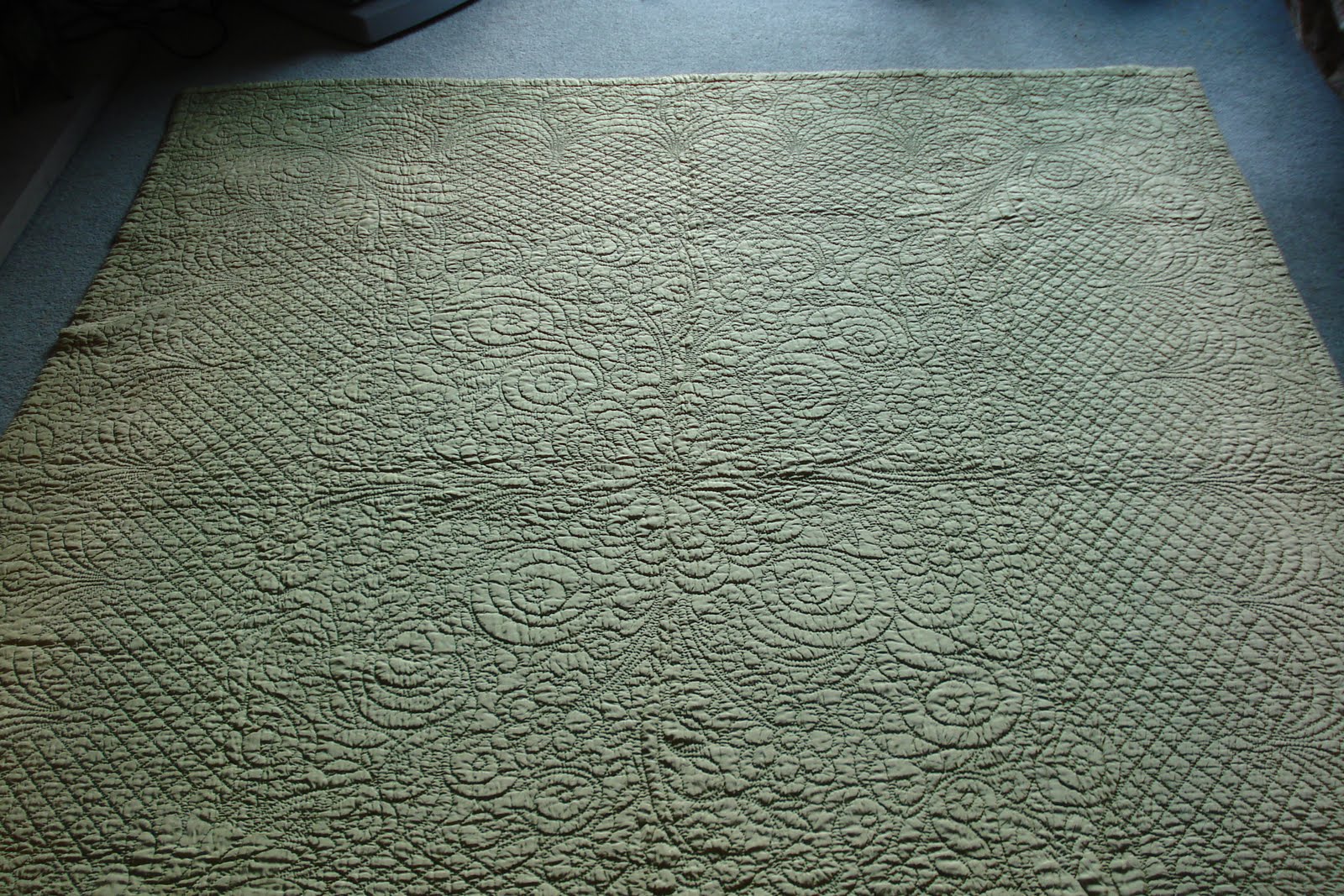
The front of the quilt in the sage green taffeta. This is a stamped quilt although there are no markings to be seen. There is a large central rose, surrounded by large scrolls and leaves. Crosshatching separates the border of hammocks.


Central area with the four large scrolls.


There is a corner area of scrolls and leaves that is nicely arranged. The edge is neatly handsewn.

The lime green cotton sateen reverse. You can see that this side has some sun fading along the folds but the quilt appears unused.


Central area of the reverse.


Here are the labels - a paper one which states the size and "Green Taffeta" and a hand written one (in Pigma pen, so recent?) with the quilter's and owner's names.


Lilian Hedley wrote - I haven't heard of her, £10 was a lot for a quilt at that time and I do query that amount. A number of years ago I discovered that a lady who had given a quilt to Beamish was still alive ( see page 101 of Quits and Coverlets) .....she told me both herself and her sister were engaged to be married but the war broke out and the men were called up, they decided to bring the weddings forward and asked Mary Potts if she would make a quilt for each of them. They cost 3 guineas (£3.3s) and she paid a shilling a week until paid for. She went to the Co-op to pick the fabric, but I have no idea if it was "all in" or the fabric separate, it didn't occur to me to ask. Even if the fabric was separate, it wouldn't come to £10, that was a fortune then."


And later Lilian also wrote - "By the way, I have an old newspaper piece about Florence Fletcher around 1960 who quoted quilts as being made for about £20, the wages in 1960 were vastly different from 1939, I still cannot get my head around that £10 quilt."

Saturday, 26 November 2011

Red Quilt Update

Update on the red Durham quilt that I showed in a recent post. I had an email from Lilian Hedley, who wrote "I love the red quilt. It is very much a stamped quilt but not in the normal style. Lots of stampers' templates used and beautifully drawn with a very practiced hand. It reminds me very much of one at Beamish. Quilts and Coverlets page 101 has a lot of the same templates and I am convinced it was not drawn by the quilter in Chester-le-Street unless she lived in the Allan or Weardale valley before she married. The more I look at it, the more I see how very similar they are. Lilian."


Here is a photo of that quilt shown on page 101 of Quilts and Coverlets - it would be better if you got out your own copy to look at! It is very similar in the borders and feathers, although the centre is very different. Quilted by Mary Potts of Chester-le-Street in 1939.


I wrote back "I was amazed to see the quilt in the book - thanks for spotting it - the centre is different but the borders and especially the feathers look by the same hand. Yes, I can see that the marker and the quilter could well be different people - it could have been marked by someone else and then quilted by Mary Potts. "


Interesting to see the date - 1939-I knew that it felt later in date and that is interesting to know.


Here you can see the border which is the same as the Beamish quilt.


The feathers look the same, as well.


Lilian wrote back - "You have got an amazing bargain with the red quilt. I am going to the archives with my sister next week to check up on both the Chester-le-Street quilters, my sister teaches genealogy and will point me in the right directions, will let you know what I find out."


In my next post, I will show you another quilt (early xmas present to myself) made in 1939 by Annie Penrith of Chester-le-Street for Mrs Whaley of Lanchester. Lilian (who lives in Chester-le-Street)had not heard of this quilter.

Wednesday, 23 November 2011

Welsh Wool Patchwork Quilt

Here is the other quilt that was found in the loft in Llanelli. It is a Welsh patchwork quilt made of woollen offcuts. It is very heavy and was undoubtedly a very warm bedcover. It is a large quilt too, at 72 by 68 inches.

Various offcuts of wool including suitings have been hand stitched together to form a geometric pattern. The red square in the middle is cotton that has been pieced together by machine.


You can see that the white wool fabric was a coarse weave and has pulled loose at one side, revealing some black wool blanket underneath. Other areas of the quilt show white and grey blankets as wadding so the stuffing is a real mix.


The pieces are all roughly sewn by hand.


To the left, grey pieces of twill suiting, and to the right, tartan, I think this is used in the traditional Welsh costume as shirt material. It is a very cheerful fabric.


Some of the wools have slubs, either this is homespun, but more likely, a decorative effect.


The reverse of the quilt is two pieces of the same woollen fabric, one is 45 inches in width, the other 24. You can see the traditional central circle and spirals. The quilting was done from this side in the frame.


Much of the quilting is done in this chevron pattern.


A utility quilt, made of offcuts and hand quilted. Poverty meant that fabric was saved and laboriously hand quilted - labour was very cheap at the time and materials were few.

Monday, 21 November 2011

Turkey Red and White Quilt from Llanelli

Here is a red and white quilt from Llanelli, Wales. Apart from the hand quilting, it is entirely sewn by machine. Someone was either an expert seamstress, or very proud of their sewing machine!

The quilt measures 82 x 76 inches, and has various sized stars and blocks on the front.


The quilt is worn and was rather musty and grubby. It had been stored in a loft for many years. I did wash it but some stains and dirt remain. The edges are frayed in places.


The interesting thing to note is that the stars are machine applique, done by top stitching the shapes, layering one star atop another.


The edge is machine sewn. The hand quilting is just chevrons and could be from anywhere.


The back of the quilt is all machine pieced and is the typical Welsh pinwheel design surrounded with squares and rectangles.


Some of the fabric here was of a lesser quality and has worn through in places. Better fabric alongside has lasted well.


It is difficult to date this quilt - the plain fabrics could be from any date - but I rather think that it is older, about 1900. It has seen a great amount of use.


This quilt was found in a loft by the decorator when a house was being cleared prior to renovation. The house had been left to a relative who had no interest or knowledge of the items. Two quilts were found in a old blanket box amongst other old items. The family that once lived there had lived in Llanelli for the past 70 years, and before that, in rural Llanelli.


In the next post, I will show you a heavy wool quilt that was found with this one, made from locally-made woollen offcuts.

Friday, 18 November 2011

Red Durham Quilt

Here is a quilt that I bought recently. It is a well marked Durham quilt in a mid-red colour cotton sateen. It is a large quilt at 104 x 80 inches. It has only light wear, but there were a few stains and it was generally grubby, having been in store for a number of years. So I did the washing-in-the-bathtub-with-Synthrapol thing. It came out fresher - and although the stains had not disappeared, they were much smaller.


The centre of the quilt has cross hatching with swags forming a central area - this is surrounded by feathers, leaves and swirls. Can you see the rather semicircular feathers? You can just imagine someone drawing these in with chalk or blue pencil.

The border is an attractive scroll design . Double lines hold it apart from the rest of the quilting designs. You can see that the quilter has not tried to turn the corner! but has put a separate scroll motif in the corners.

The attractive border design. This quilt is obviously drawn out on the quilt - it is not a "stamped" quilt but has been marked out by an experienced quilter. Because of the plain fabric, it is hard to assign a date to the quilt. The seller thought 1880's but I don't think it is that old. Perhaps 1920's?


One of the odd things about this quilt is the fact that at each corner there is a tie sewn in place- not very long. Was it used as a mattress cover or on a settee? Or were the ties used to create a bundle of bedding that could be easily stored? suggestions welcomed!! The ties do not seem long enough to secure the quilt to a four poster bed...


This quilt was bought many years ago by the seller in Leominster, Worcestershire for £80. Of course this is another of my Ebay finds and needless to say, I did not pay anything like that amount. I am going to have a go at tracing the motifs on this quilt as they are really attractive.A very serviceable quilt with some nice quilting designs.

Wednesday, 16 November 2011

"Comfy" Quilts

I have two "Comfy" quilts - this is the very-much-used one. These quilts came in a great variety of colours, but this diamond shape was the standard variety. You still see a lot of these about - they were factory-made quilts and they did supplant the hand sewn quilts although they were not cheap to buy.

Jan Rae's article will give a lot of detailed information on these quilts. Her talk was fascinating but unfortunately I did not take notes. Comfy quilts were made by the British Quilting Company in Holt Holme Mill, Waterfoot, Rawtenstall, Rossendale. The company was difficult to track down, it was no longer registered with Companies House - but cleverly, Jan was able to check the registered logo and discover the company details that way. She was then able to access local records and archives. Also, through day exhibits in two local libraries, Jan was able to meet former employees. The company was a relatively large and prosperous company in its heyday, but the company closed in 1970 after sales fell off.


The two sides of the quilt are reversed plain and print fabric - that is because the diamond shape was cut out from the (already quilted) quilt sandwich and the shape turned over. Then the cut edges were covered with a tape and the edges sewn down. The quilting was always done in a zigzag pattern by a special quilting machine imported from America.


Here is my better "Comfy" quilt - it is unused, but it is a wholecloth type in a green print - no diamond shape here.


And here is the fabric Comfy label. Sometimes there is a paper label as well. Most of the quilts have long since lost their labels. Quite a few people grew up sleeping under one of these quilts!

Monday, 14 November 2011

What I brought back from Gregynog...

Of course I made some purchases while I was in Wales... I bought some repro fabric from the little quilt shop in Lampeter and another thimble...

Then while at Gregynog I bought two of Kathryn Berenson's books - one on the Guicciardini Tristan Quilt in the Bargello Museum in Italy - the other on Marseille work. Both are very well researched.


Susan L. lent me a copy of Emiah Jones's diary - now out of print - I shall have to make a copy, as it is an interesting read -


There was a table with books and other things (including old quilts) that members had brought to sell - BQSG received 20% of the sale price. Via Pauline Adams I bought two quilting frames -this one is of very traditional design, and formerly belonged to Angela Brocklebank. This frame is smaller (not full size) and I have plans to use a special length of fabric to make a cot quilt to try this frame out.


The other frame is more modern, formerly belonging to Madeleine Howard who lives in Essex. This is a larger frame with folding legs. I shall have to try and use these for some of my quilting projects. As you may remember, I use a plastic Q-Snap quilting frame which has served me well for many years. But it will be nice to try these two quilting frames out. I'll let you know how I get on, in due course.

Next few posts - back to old quilts!!