Search This Blog

I am a quilter living in Woodbridge, Suffolk who has made quilts since I was a teenager. I also ring bells! Both are great British traditions....I will try to feature some of my antique Welsh and Durham quilts, the quilts I make myself, my quilting activities and also some of my bellringing achievements. Plus as many photos as I can manage. NB: Double click on the photos to see greater detail, then use back button to return to the main page.


Wednesday, 16 November 2011

"Comfy" Quilts

I have two "Comfy" quilts - this is the very-much-used one. These quilts came in a great variety of colours, but this diamond shape was the standard variety. You still see a lot of these about - they were factory-made quilts and they did supplant the hand sewn quilts although they were not cheap to buy.

Jan Rae's article will give a lot of detailed information on these quilts. Her talk was fascinating but unfortunately I did not take notes. Comfy quilts were made by the British Quilting Company in Holt Holme Mill, Waterfoot, Rawtenstall, Rossendale. The company was difficult to track down, it was no longer registered with Companies House - but cleverly, Jan was able to check the registered logo and discover the company details that way. She was then able to access local records and archives. Also, through day exhibits in two local libraries, Jan was able to meet former employees. The company was a relatively large and prosperous company in its heyday, but the company closed in 1970 after sales fell off.


The two sides of the quilt are reversed plain and print fabric - that is because the diamond shape was cut out from the (already quilted) quilt sandwich and the shape turned over. Then the cut edges were covered with a tape and the edges sewn down. The quilting was always done in a zigzag pattern by a special quilting machine imported from America.


Here is my better "Comfy" quilt - it is unused, but it is a wholecloth type in a green print - no diamond shape here.


And here is the fabric Comfy label. Sometimes there is a paper label as well. Most of the quilts have long since lost their labels. Quite a few people grew up sleeping under one of these quilts!

Monday, 14 November 2011

What I brought back from Gregynog...

Of course I made some purchases while I was in Wales... I bought some repro fabric from the little quilt shop in Lampeter and another thimble...

Then while at Gregynog I bought two of Kathryn Berenson's books - one on the Guicciardini Tristan Quilt in the Bargello Museum in Italy - the other on Marseille work. Both are very well researched.


Susan L. lent me a copy of Emiah Jones's diary - now out of print - I shall have to make a copy, as it is an interesting read -


There was a table with books and other things (including old quilts) that members had brought to sell - BQSG received 20% of the sale price. Via Pauline Adams I bought two quilting frames -this one is of very traditional design, and formerly belonged to Angela Brocklebank. This frame is smaller (not full size) and I have plans to use a special length of fabric to make a cot quilt to try this frame out.


The other frame is more modern, formerly belonging to Madeleine Howard who lives in Essex. This is a larger frame with folding legs. I shall have to try and use these for some of my quilting projects. As you may remember, I use a plastic Q-Snap quilting frame which has served me well for many years. But it will be nice to try these two quilting frames out. I'll let you know how I get on, in due course.

Next few posts - back to old quilts!!

Saturday, 12 November 2011

Gregynog nr Newtown, Wales

Our BQSG seminar was held at Gregynog - it was formerly the grand house of two sisters, but is now a teaching, seminar and conference centre for the University of Wales. It must have been a large estate, as it was a long drive to the house from the main road.


The view from my bedroom!


I was cold during the first night - I got up to search for some blankets - here is what I found in the wardrobe - two tapestry blankets! Very warm!


An amusing sign - I had to investigate -- the other language is obviously Welsh.....


More explanation- not in Welsh this time ...

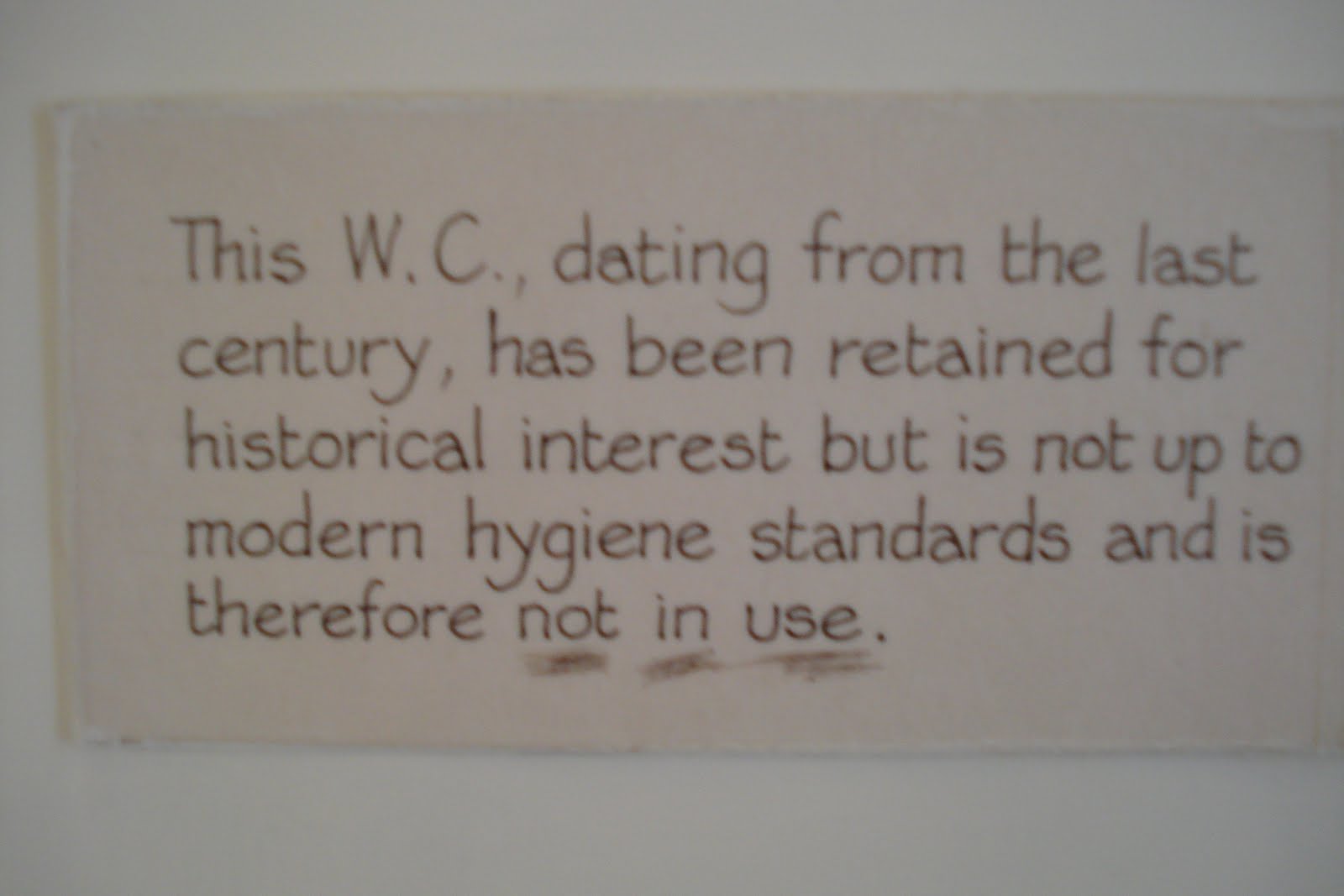
A Victorian W.C. with a manual pump, all hidden under a neat wooden flap...the same in any language...

Now to the real business....we had some excellent papers. They were all very interesting and well presented. I am looking forward to seeing the next volume of Quilt Studies where the papers will be published.


Kathryn Berenson, who lives in Paris (lucky woman!) gave a paper on Quilted Works of Naples - the French and Italian context of the Tristan Quilts. Very scholarly and lovely illustrations.


Maxine March gave a paper on a red cross quilt now in the Imperial War Museum- The Marchant Grove Quilt. This was a very moving talk in which Maxine related how she tracked down a no longer extant village in Saskatchewan, Canada and made contact with people living in the area. The quilt is embroidered with the names of servicemen, and she was able to track down amay of the families. Many photos were shown, very interesting, this talk was many people's favorite as it was so evocative of the times in which it was made.


Anita Loscalzo gave a talk on two bedcovers which had images of Charlotte Princess of Wales. These are in the New England Quilt Museum.


After tea (excellent food throughout, by the way) we had a talk by Roger Clive-Powell (Jen Jones other half) on quilt photography. I took several photography courses at Smith and I am glad to say that this made me dust off the old brain cells and chimed with what I had learnt all those years ago. Roger photographs the quilts himself. This takes place outside - there was an amusing drawing of a wicked looking cloud emerging over a hill, headed towards the photography set up - an angled board holds the quilt while a tall scaffold holds the photographer and camera. Roger uses a film camera and an instant or light received setting. Later the film images are scanned to digital. I too find that natural light seems to bring up the quilting better than artificial light.


An after dinner talk by Jen Jones was very enjoyable and we saw some wonderful images of Jen's quilt collection.Of course she related the story of the conversion of old Town Hall to Quilt Museum. I was interested to see photos of the quilt storage area - all the quilts are folded flat, as Jen feels that rolling the quilts places stress on the quilting stitches.


Jan Rae gave a very interesting talk on the "Comfy" brand quilt - now known to have been manufactured in Rawtenstall, Lancashire by the British Quilt Company. She investigated records and spoke to former employees. There are still many of these quilts around, I have two myself!


And finally Geoff Crumplin gave a talk on quilt blocks - paper folding was an easy and accurate way of drafting quilt blocks in the days before photographs and .pdfs.


The venue for next years seminar has yet to be fixed - it was to be York, in conjunction with the BQSG exhibition at the Quilt Museum, but as that has been postponed, an alternative has to be found. As there were so many textile producing areas and as there are so many museum collections, it really comes down to finding suitable accommodation, but wherever it may be, I am looking forward to it....

Tuesday, 8 November 2011

Quilt Association, Minerva Centre, Llanidloes

After my visit to the Quilt Museum, I retraced my steps, back to Llanidloes, where there was a special display of quilts put on for the members of the British Quilt Study Group. I am a member of the Quilt Association and had been here twice before, most notably, for the workshop on fabric dating with Philip Sykas.

There were some great quilts on display.


Quilt made of suiting samples - made by Mrs Gethin of Cwm Belan near Llanidloes. there were several woollen mills in and around Llanidloes.
I think this was my favorite!!


Detail of centre, wholecloth quilt - in boxy Carmarthenshire style.


This quilt is faded and a brown colour now, but would originally been a mauve colour.


Military quilt, made from army uniform fabrics. From the Thomas family in S Wales. It was made by a relative in the Talgarth area, where there was a convalescent home for soldiers. No backing, these were often used as tablecloths or throws.


Applique quilt in red and white, made near Llanidloes. This quilt is all in standard applique, there is no reverse applique.


Bowtie quilt made in woollen fabrics - made mid 19th c in Mid Wales.


Tracing of the Starfish quilt. This quilt was bought at auction and came from the Haverfordwest area. It is much older than previously thought (possibly 1840s) and is a high status object. The fabrics include worsted wools for the front, some callendered and moireed, with linen as the backing. Very elaborate quilting designs, including baskets of flowers. This photo shows the tracing hanging in front of the quilt. Led by Pauline Adams, it took three ladies a weekend to complete the tracing, and is on medium weight polythene (horticultural grade) with a permanent marker. See an earlier post for more details if you are interested in this technique of tracing quilt patterns.

Susan Levett is currently writing a paper on this quilt, which will be presented to the BQSG next year.


The Quilt Association has a summer exhibition, which combines antique quilts with modern quilt makers' work. It runs from July through to September. Next year I will be lending quilts from my collection and am pleased to be able to do this. All I have to do next is to decide which ones!

Monday, 7 November 2011

Welsh Woven Blankets at the Quilt Museum

Before I show you the quilts from the Minerva Centre, I just thought that I would show you the woven woollen blankets that were on display in a side room of Jen Jones' Quilt Museum. The shop has been selling A LOT of blankets recently - more than quilts - and Hazel from the shop thought that some of the blankets from the collection should also be on display. Some of these blankets have clear similarities with the Welsh quilts. Or is it that the quilts mimic the blankets? At one time, there were many, many local mills in Wales producing woollen fabrics and woven blankets. A few still survive.


Woven blanket commemorating Canaervon Castle and the University of Wales. Notice the woven leeks in the border!!


A woven blanket that has similar borders and patches to a quilt - and also looks rather Amish, if you ignore the brown colour (not a favorite colour in the conservative communities) .


Woven coverlet - looks like the patterns that my grandmother used to weave on her loom - and notice the borders again.


Stack of older woven blankets - these were woven on narrow looms, thus have a seam down the middle where two widths were joined together. Very collectible now.


The price of these Welsh blankets has shot up recently - they are nice to have on a bed and do look very cosy. As long as you use them and keep moving them, moths shouldn't be a problem.

Friday, 4 November 2011

Quilt Museum at Lampeter - 3

The final lot of photos taken at the Jen Jones Welsh Quilt Centre, Old Town Hall, Lampeter. As before, I am not including too much information. I would strongly encourage you to buy the catalog (available in English or Welsh), which contains more information on these quilts, from http://www.jen-jones.com/. There will also be a DVD available soon, which will have photos of all three exhibitions, together with more detailed commentary on a few of the quilts.


Here is my favorite quilt of the show - a stunning yellow wholecloth with just beautiful quilting. Both sides were available for inspection.


A closer look at the quilting, which includes "coins" spirals, fans, chevrons and more. Made by Anna Davies of Whitland, Carmarthenshire.


Scalloped edge cot quilt circa 1930.


I found these photos in the hall. The quilters in the larger photo were from Solva and the photographer was Margaret Wright. I wonder who the man in the other photo is?


Here he is in another photo, talking to Jen and Roger.


I was interested to see this quilting frame, with part of a quilt still attached and the quilt backing.


The quilting shows the traditional Welsh leaves and spirals


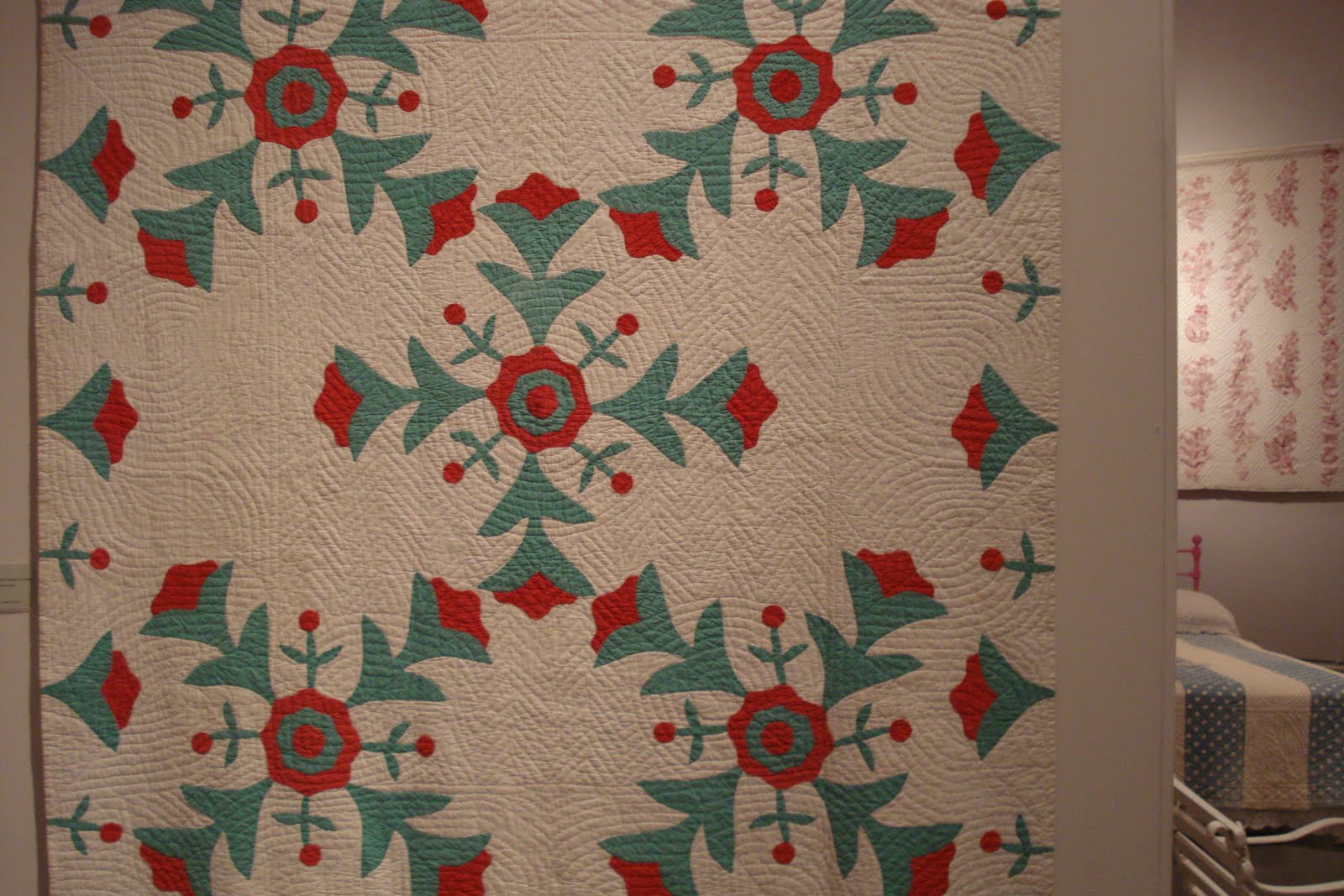
Applique quilt which doesn't seem to be in the catalog!!


Beautiful array of red and white quilts. The one on the bed is from Llanybydder, late 19th C - the one on the wall is from the 1890's.


Well, that is the end of my photos from Jen's exhibition - next, photos from The Quilt Association at the Minerva Centre.

Tuesday, 1 November 2011

Quilt Museum at Lampeter - 2

Here are some more photos taken at the Jen Jones Welsh Quilt Centre, Old Town Hall, Lampeter. As before, I am not including too much information. I would strongly encourage you to buy the catalog (available in English or Welsh), which contains more information on these quilts, from http://www.jen-jones.com/. There will also be a DVD available soon, which will have photos of all three exhibitions, together with more detailed commentary on a few of the quilts.

Patchwork quilt from Ammanford, dated 1893.


Handkerchief quilt, Carmarthenshire about 1900.


Display which includes a pink and blue patchwork from the Lampeter area, 1920's.


A beautiful red and white strippy - it won a prize for May Thomas of Llanelli in 1901. This quilt was another that had to be sent off to a conservator for cleaning - Jen said that it was returned with a little packet containing the removed dirt and grime.


The Treaga family immigrated to Pennsylvania, so this quilt has definite American overtones although the quilting is pure Welsh.


Patchwork quilt with appliqued hearts.


Basket quilt, mid Wales.


Applique quilt made in 1890's by Catherine James.