Search This Blog

I am a quilter living in Woodbridge, Suffolk who has made quilts since I was a teenager. I also ring bells! Both are great British traditions....I will try to feature some of my antique Welsh and Durham quilts, the quilts I make myself, my quilting activities and also some of my bellringing achievements. Plus as many photos as I can manage. NB: Double click on the photos to see greater detail, then use back button to return to the main page.


Wednesday, 30 March 2011

Ringing Weekend to Staffordshire

Mike and I went on a ringing weekend to Staffordshire - an outing arranged by our friend Paul Norris of Norfolk. A variety of ringers from Suffolk and Norfolk came, together with a friend local to the area, Mitch. Paul had arranged a number of quarter peals for the more experienced ringers, while the learners had lots of practice under supervision. I rang in twelve attempts, ten of which were successful, and "grabbed " seventeen new towers. We stayed at The Piano Barn in Newborough - the same place we stayed when we had a similar outing eighteen months ago. But this time Paul hired the adjoining property as well, Poplar Farm. Each sleeps 8 or 9, so are very popular for family reunions, hen parties, and school reunions etc. We were allowed to carry the large kitchen table from one house to the other so that we could all have evening meals together - very pleasant.
We rang Cambridge Major at this tower, Mavesyn Ridware, eight bells 8cwt. This is an estate church and has some fantastic mediaeval tombs inside.
Another church that we rung at - Hoar Cross. This has a lovely heavy ring of six -heavy at 28 cwt but they go very well. This church was built by a wealthy widow in the 1860's and is a perfect example of a Victorian church built in an idealised Mediaeval decorated style. The church interior is stunning as the fittings are very sumptuous in the Anglo-Catholic style.


Having rung a quarter of Plain Bob Minor on the bells last time, this time the ringers went for Cambridge Minor ( more difficult as the bells have to dodge about more - not easy with such heavy bells). It sounded lovely and all were very pleased at the quarter. Here is Mike Clements ringing the backstroke on the tenor bell (the heaviest bell) while Mike is just about to catch the sally for handstroke. You can see the concentration!


We also rang at Abbotts Bromley, another nice eight. This church is famous as the resting place for a set of prehistoric horns, used in the famous annual Abbotts Bromley Horn Dance. I would like to see this - perhaps I'll have to go onto Utube and have a look. Last time we were a day too early. It seems that the dancers wear the heavy headpieces and dance about the village - stopping at each pub in turn and getting mightily drunk in the process. The dance takes an entire day and attracts massive crowds. Scientific research has shown that these horns are indeed authentic survivors of great antiquity, not a later invention. Of course the horns are reindeer horns which are not native to Britain. The horns rest in the church and are not allowed to leave - there is another set of replicas which can be taken to different festivals, though. The dancers positions are hereditary I think. A good example of the church taking over pre-existing pagan customs.


Hanbury, where we rang a quarter of Grandsire Triples. The weather was glorious and you can see that the daffodils were out in force.


Many thanks to Paul for arranging this, I only regret that we lost the Grandsire Caters at Loughborough Parish Church - it seemed to be going so well before it went all very wrong!!

Tuesday, 29 March 2011

Tuesday morning!

Hi folks, sorry not to be in touch but from Friday to Monday I have been away in Staffordshire on a ringing weekend with friends from Suffolk and Norfolk. Twelve quarter peal attempts for me with ten scored. Eighteen new towers!I will be blogging about this in a day or two when I have recovered! some very pretty countryside with some industrial bits..... Just to say that I will be drafting the instructions for the bell block tonight and I will be sending them out over the next day or so.

Sunday, 27 March 2011

Christchurch Cathedral New Zealand Commemorative Quilt - Call for Blocks

On the 22nd February, Christchurch New Zealand was struck by an earthquake, causing widespread damage. Christchurch Cathedral's spire collapsed and there was devastating damage to the rest of the Cathedral structure. More information here : http://www.christchurchcathedral.co.nz/ Luckily, no bodies were discovered in the rubble. The ring of twelve bells was destroyed, although several of the bells have been recovered, with damaged fittings.


The collapsed spire of the Cathedral.


The recovered bells amongst the rubble of the tower. Hopefully, you can see the shape of these bells and the general colour.

Bellringing is an old tradition, and bellringers are very much a worldwide community. Ringing societies in Australia, North America and the United Kingdom have already promised help. It will undoubtedly take some time to rebuild the tower and restore the bells.


Karen R., a Christchurch bellringer and quilter, wants to make a commemorative "bell" quilt and I suggested that I would be willing to co-ordinate efforts.


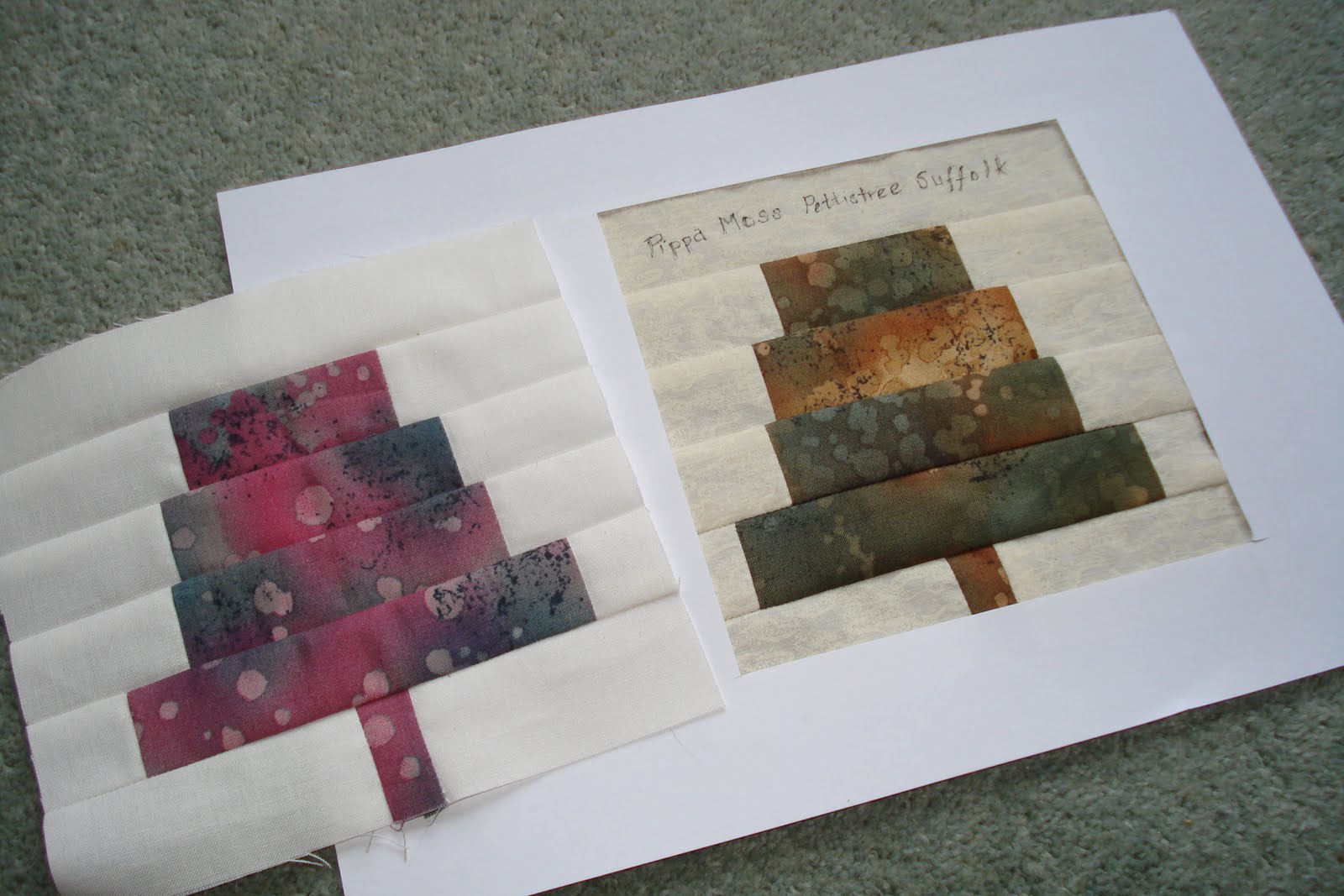
I am asking ringers/quilters to make a 6 inch " bell" block that I have designed - it is based on an old pattern called "monument". I am suggesting "bell" colours - mid to dark browns, bronze or slate colours, with a variety of off white/cream/ecru backgrounds. I am asking the makers to sign the block with their name, town and country, or if a ringer with their home tower.


I think this block would look good in repro fabrics, especially the civil war fabrics - and shirtings?? although I don't own many myself.


Here is the block - I have tried to keep to the change ringing bell shape - there is a clapper too, at the bottom. No headstock though.


Here you can see the finished and unfinished blocks. I have signed one of the blocks. The block is 6 1/2 inches unfinished, 6 inches finished size.

I will make a central panel (with Ruth McDowel's techniques) using a suitable photo of Christchurch - possibly the photo of the bells shown above.


For the border, I had envisaged a border based on this free machine quilted leaf and vine pattern, although with bell shapes.

I hope that all blocks can be submitted by the end of May, so that I can complete the quilt in time for the Festival Of Quilts in August. Afterwards, it will be sent to New Zealand. If you wish to participate (and I hope that many of you will) please send me an email (address is on the profile page) and I will send you an attachment with instructions for this block. No matching up intersections of seams - so should be achievable....Many thanks, Pippa

Sunday, 20 March 2011

Tom well in Hiroshima


My son Tom was planning to fly out to Tokyo last Saturday, to visit his girlfriend Lily.. When I found out that he had changed his plans and flown out to Hiroshima, I was concerned! However, I have just had an email which says:
"We're a long way from Tokyo here in Hiroshima. Hiroshima didn't even experience the earthquake. I don't feel in any danger at all. In fact, I have witnessed some of the most esquisite architecture the world has to offer.
We are travelling to Hiroshima, Awaji, Kyoto, Fukuoka and Naoshima."
And he promises to check his emails more often. It seems that there has been some scaremongering by the press, although the situation is serious.
Tom works as an architect and the picture above is of Fukokaji (panorama).
More posts later, on progress with the sawtooth top -its complete and being marked now.

Wednesday, 16 March 2011

Blue and Pink Durham Quilt

Here is a pink and blue Durham quilt that I bought recently from Louise Loves in Builth Wells. It measures 1.8 m x 2.3 m (that's 71 by 91 inches).
No provenance on this quilt.

Generally, my buying days are over, but as you know, I really am interested in these stamped quilts....a reasonable price considering the age and the amount of work in it. These designs were marked - the earlier ones were quite elaborate - the later ones quite simplified - this is somewhere in between. Perhaps 1920's??

That's Monkey on the right.....little helper....


Here is the centre - a rose with some fleur de lys and a flower design. The stitching and the infill squares are nicely done.


Here is the corner treatment- rather cheerful - swags plus roses, a fleur de lys, with an inner running feather.


I was puzzled by this design - it looked like a long stemmed rose - with coins - but what was around it?


I traced it, and you can see that it is a rose with a long stem - then coins (they used pennies to trace around, but the lowest one is another, smaller coin?) and also a wreath of leaves which is not very visible with the infill grid.


Here are the two sides - the thread is white, but from the stitching, you can tell that the blue side is the top side - unfortunately, the blue side is faded from being folded and placed where the sun could reach it.


You can see that one half is relatively unfaded while the other is very faded in parts .


Just for fun, I tried to fold the quilt to match the fades, to discover whether it had been folded in a particular way - I folded it in half - then it was not so easy - this seemed to be the most likely but perhaps it was refolded?

A nice quilt with some nice patterns - there is cotton wadding inside and it is double sewn on the edge, by machine.

Monday, 14 March 2011

Old Quilting Patterns - Oklahoma 1930's

I was looking through this folder today - it is a collection of sewing patterns that belonged to my grandmother, Marie Fuller. Most are patchwork patterns, but there are knitting and crossstitch patterns as well. The patchwork patterns show no sign of being used - but Marie was a weaver, not a quilter. Most date from the 30's. although some are earlier or later in date. Marie was living near Enid Oklahoma by this point, having had to give up their family home near Dearborn during the Depression.

I tried to give these items to the Quilters Guild, but as they were not of British origin, they could not accept them.

Here are some patchwork templates - unused! - for house, basket and double wedding ring blocks. All are by Grandmother Clark's, a firm in St.Louis, Mo. There is no price quoted.

Here is another list for patterns by Grandmother Clark's - and a cardboard with tracings for another block (not precut - pattern 22 - a pattern made with diamonds).


This is a pamphlet with patterns available from Mountain Mist -Stearns and Foster, Cincinnati - prices 20 and 35 cents, unles one had a coupon found inside the wadding, then 10 and 20 cents. A roll of cotton batting was $2 or $ 2.25 for cotton or $6 or $7 for Dacron (this must be a later list?)

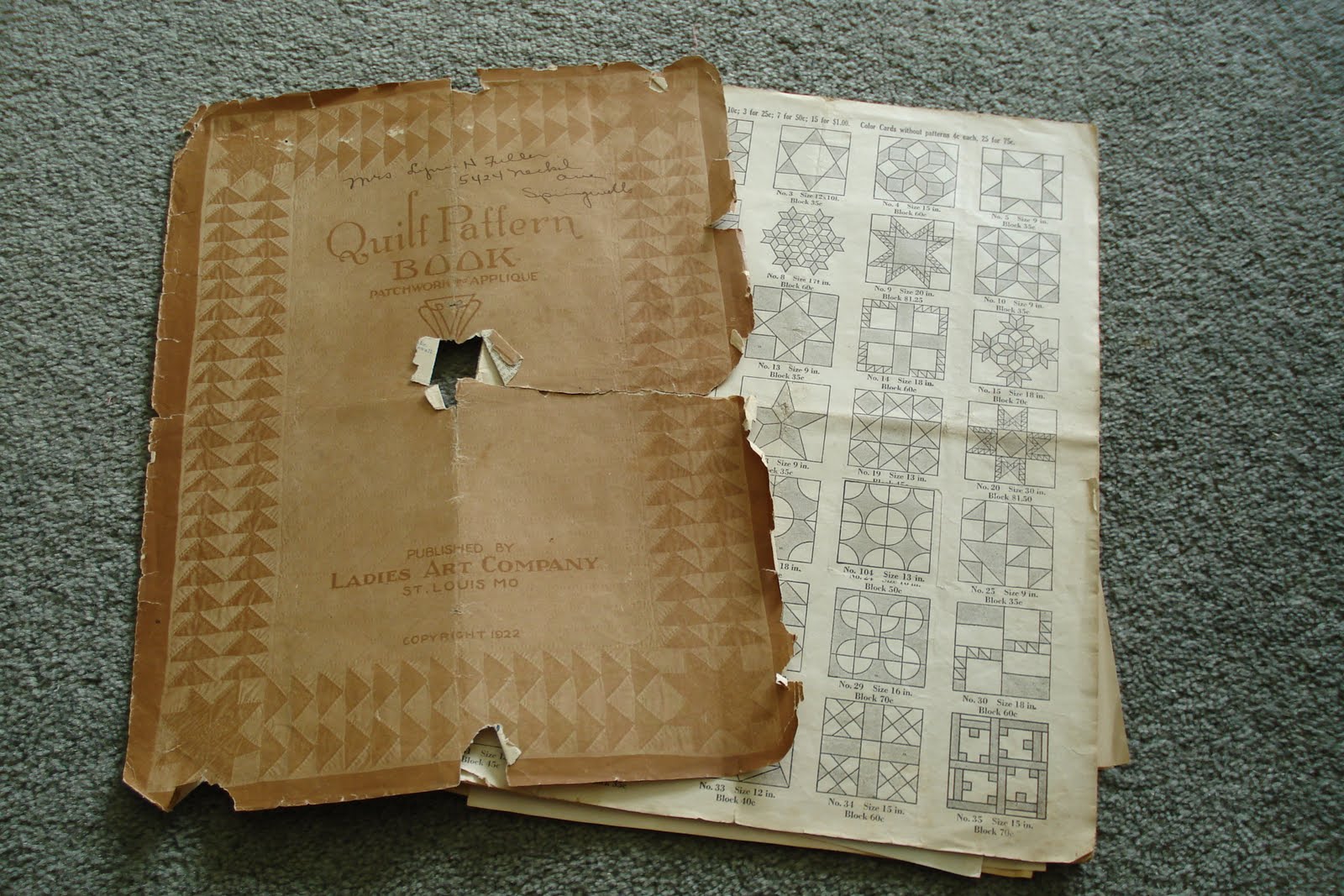
Here is a booklet of quilting patterns by the Ladies Art Company of St.Louis - dated 1922. It has written on the cover the name Mrs Lynn Fuller. You were able to buy patterns on colored card for 10 cents each, and you could also buy finished calico blocks from 35 cents to $1.50. There are quilting designs and also stamping patterns for redwork,

Here is a book for "War Work" - Comforts for Soldiers and Sailors - Also Knitted Garments for the Boy Scout - published by Priscilla Publishing Co of Boston Mass. Price 25 cents. The date is 1917 so must date from the First World War.


Included are patterns for knitted mufflers, sweaters, socks,mittens and also hospital garments in cotton. Shown is a pattern for a knitted helmet. To the back of the book is an article " One Thousand Dollars for Red Cross Work can be raised by Means of a Memorial Quilt " , a quilt campaign specially adapted for church and womens clubs. Squares and spaces were inscribed with the name of the donor in ink or embroidered in red outline. The block pattern is a red cross on a white background.


There is also a large collection of clippings from local Oklahoma newspapers - these were syndicated columns and the reader was invited to purchase patterns from various companies. Ruth has tipped them into paper to preserve them.Most are from the 30's.


Many of the patterns are fairly simple ones, but a few are more complex, for the more experienced quilter. Here are shown New York Beauty and Indian Wedding Ring.
I will have to look at these more closely - proof that things haven't moved on all that much - we still do the same sort of thing, except our tools are much more complex - and we use more electicity I think!

Sunday, 13 March 2011

Rothbury Brown Durham Quilt

Here ia a magnificent Durham quilt in a golden brown colour. It is a very large quilt - the size is 105 x 88 inches. The wadding is cotton and the quilt appears either very lightly used or unused. The quilt came from an auction house in Rothbury which deals in house clearances so is likely to be from Northumberland.

The centre of the quilt has a magnificent circle of curved feathers with a rose at the centre. The quilt is wide and is made of three fabric panels; one is reversed in the direction of grain so appears a slightly different colour but is in fact the same fabric.


On the outside are daisies plus more feathers - this group of three feathers is known as Prince of Wales feathers.


On two sides of the quilt is a running feather border....


On the other two ends is this unusual border - a looped pattern filled with leaves...


The edge is machine sewn in two places but has a unusual wavy line - very attractive. I did not photograph it, but in one small area the quilting was not completed - so the person at the sewing machine has filled the unquilted area in with circles of machine sewing - all in white - very strange as it is very visible against the brown fabric and the lovely hand quilting - perhaps they were more proud of their sewing machines then...