Search This Blog

I am a quilter living in Woodbridge, Suffolk who has made quilts since I was a teenager. I also ring bells! Both are great British traditions....I will try to feature some of my antique Welsh and Durham quilts, the quilts I make myself, my quilting activities and also some of my bellringing achievements. Plus as many photos as I can manage. NB: Double click on the photos to see greater detail, then use back button to return to the main page.


Saturday, 20 November 2010

White Cot Quilt

Here is another cot quilt - rather traditionally quilted but later in date than the other two I have shown earlier. The size is 31 x 48 inches and it is not made of cotton fabric, but an artifial fibre. The pattern is a large daisy in the centre and similar fans in the corners with an all-over wineglass filler pattern.


The stitching is neat and the edge is a sewn knife edge. The filling seems to be natural, a thin cotton wadding. The quilt comes from the Whitley Bay area of Northumberland.
The fabric is a man-made one - these were well liked for their hard wearing qualities. The first totally artifical fibre, Nylon, was developed in 1938 but did not appear on the market until after WWII. Rayon, or artifical silk, was popular from the 1930s to the 1950's and was made of cellulose, the natural compound. Acetate is a version of rayon.

I imagine that this quilt dates from the 40s or 50s but it would be nice to identify the fibre more precisely.

Friday, 12 November 2010

Progress so far with Hawaiian Quilt

I have been steadily working away on the applique of the Pilani quilt. It is about 2/3 complete and I am enjoying working on it. When it is all complete I shall go back and resew any bits that don't look smooth or nice. Then it is ready for quilting.

Cissy emailed me and told me that "Pilani was the greatest and most well known King of Maui and it is beleived that all great kings descended from him including King Kamehameha the Great. Google him and you'll learn more of this great king".

She also posted photos of my two quilts on her web site and you'll find them at www.poakalani.net/quiltsaroundtheworld.html

Several people congratulated me as they thought that my quilt was used as publicity for the Festival of Quilts - alas it was not my quilt but another vintage red and white Hawaiian quilt - one I think belongs to the American Museum in Bath.

I was able to download and print off an excellent booklet on storing and cleaning quilts from the York Quilt Museum and Gallery, under FAQs look for Cleaning and Storing Quilts and click on the highlighted link.

Subject to the necessary checks and references, I am looking forward to being the new treasurer of the BQSG - the British Quilt Study Group. This group does very valuable work and I am looking forward to getting more involved.

I am also starting to draw up a pattern for my Welsh quilt which I want to get started on. I also measured the Sawtooth Northumberland quilt top and will buy fabric to start to piece a replica of that. The quilting patterns will just be taken from the stamped top (I will trace the designs onto polythene and then just trace off with the light table) so that all seems fairly straightforward.

Its that time of year that everyone is thinking of the holiday season! I did not think that Tom and Sophie would be home this year but plans have changed and it seems that both will be home for at least part of the time, which will be great!! Time to think about my Xmas letter - last year's never got sent out as things were generally very hectic so I am going to start earlier this year...

Wednesday, 10 November 2010

Mystery Solved - Blue "Durham" Quilt


Here is a quilt that I bought (very inexpensively) about a year ago. The quilt was sold as a "Blue Durham" in the Art Deco style. It is a small single size, about 45 x 85 inches. It is worn, and has been mended, but I bought it because it appeared to have unusual quilting patterns, which I find very interesting. I'm afraid that the quilt does not photograph very well, however perhaps you can see that it does follow the frame pattern, and the quilting is fine with very intricate designs.


This is one end of the quilt - you can see that it has round "palm" designs plus chevron designs, plus filler wine glass patterns.


Here is the circular pattern, that are like palm leaves and do look a bit Art Deco-like. Very elegant.


The quilting is very fine and small - but it is all backstitching!!!


The edge has come undone - not sure if there was some sort of frill or fringe, or if it has merely come unsewn.


You can see from this that it is very worn, both on the top and also on the reverse - especially at the edges and corners.
I took this quilt to the Rochford study day - comments were:
Its not in the British quilting tradition
Continental?
Arts and Crafts movement??
Made by nuns??
Definitely dyed - the wadding is blue, too.

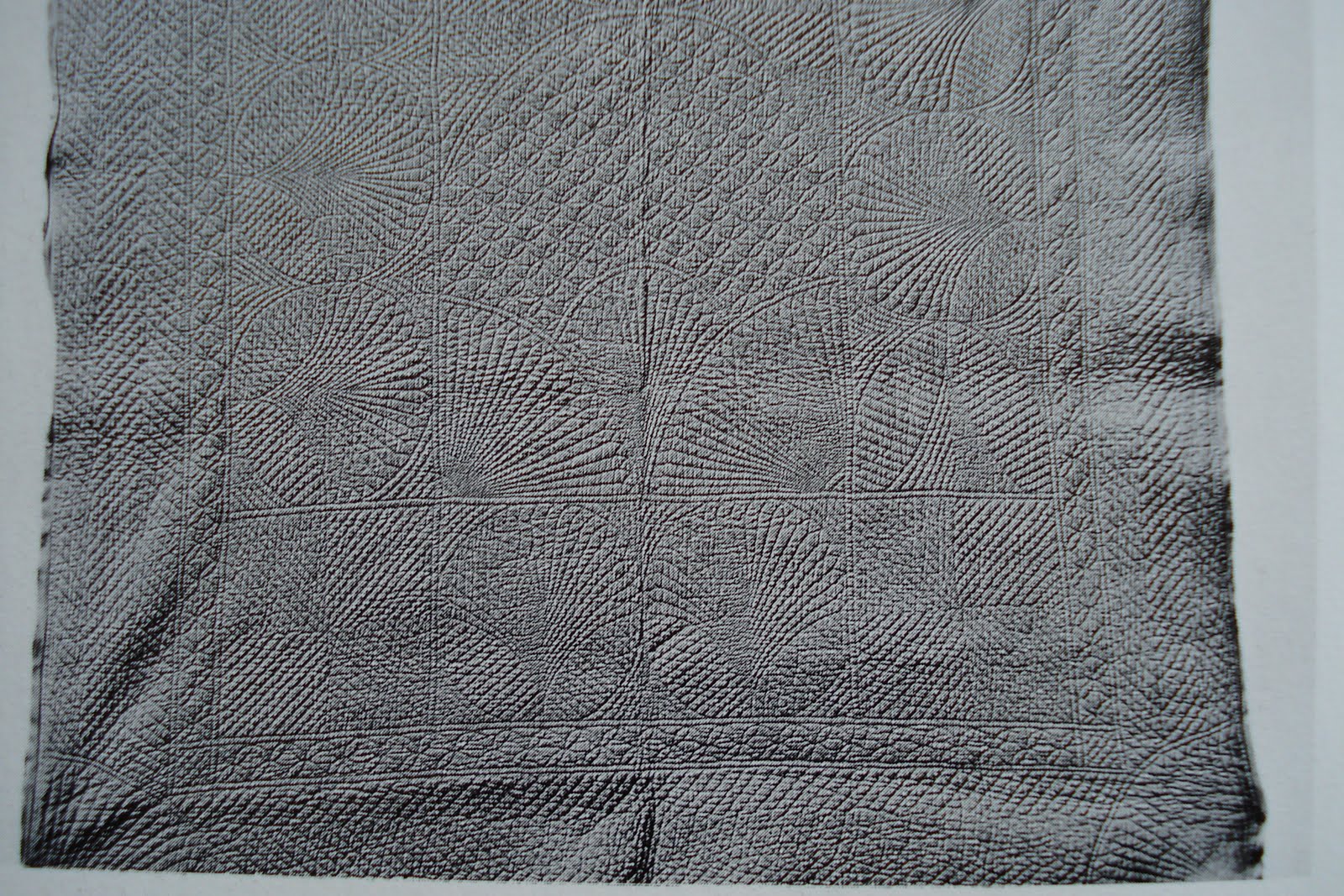
When Clare suggested that the pink sample was by the Porth quilters, I went to look at the figure in Elizabeth Hake (1937) - English Quilting - Old and New. As I was looking at the other plates, I came across this figure - number 47:


(Sorry that the photo has not come out very well - go off to your copy and have a look - the old plates are quite gray but are detailed if you look closely). The caption reads: "Indian quilt made by Himalayan women circa 1922. White linen, Backstitched, interlined with semal cotton. Note the relationship to English quilting patterns".

It struck me that this quilt was very similar to the quilt I owned - and the more I looked, the more convinced I became that this was the SAME quilt!!

I made a rough sketch of the quilt and compared the quilt with the plate - the half motifs are in the correct place - the designs are the same. I counted the "points" on each fan/palm leaf - the number varied from 19 to 25, 22 being the most common - in each case the number agreed perfectly. I did not include the corner fans, as these aren't very clear in the plate. I noticed whilst doing this, that there is a seam - this is identical in position in both - this really confirmed things for me. It does prove that the cloth is pieced and not a single piece of fabric, as the seam runs across the border but the centre fabric is entire.
It is hard to see the binding in the plate so this is still a bit of a mystery but it looks like a double binding which has become worn or undone...

So, it appears that this is the same quilt, however in the intervening years from 1937 it has been used intensively and become worn; it has been darned. Also, when the white quilt became yellowed and stained, it was dyed blue to hide these somewhat (you can still see the yellowing at the ends). How did the quilt get from Hake's book to Ebay? We can't tell as there is no other information about the quilt in the plate, we don't know who owned it or from where it came...there are no sources or attributions...at the time I bought the quilt I did email the seller - she replied "I'm afraid I don't know anything about the quilt, it came in a lot of other quite good textiles. I think it might have been made for a child's bed as its quite small. The stitching is lovely, very small but its not in very good condition, Kind Regards, Lois W."

How exciting...and also puzzling - why exactly, was this included in a book about English quilting?? other than to show that the frame format was not uniquely British--was there some English link with the Indian/Himalayan women quilters of 1922? Were quilts an indigenous craft in that area or was the sewing introduced by outsiders, as in Hawaii? Many unanswered questions - I have only two books which cover Indian quilts - one about Ralli quilts, the other, Quilted Planet by Celia Eddy. Neither has any wholecloth quilts from India, they are all patchwork or applique.
Question, questions - but I am glad to have found out more about the quilt - and very happy to have firm link with Elizabeth Hake's book.

Saturday, 6 November 2010

Pink Quilting Sample

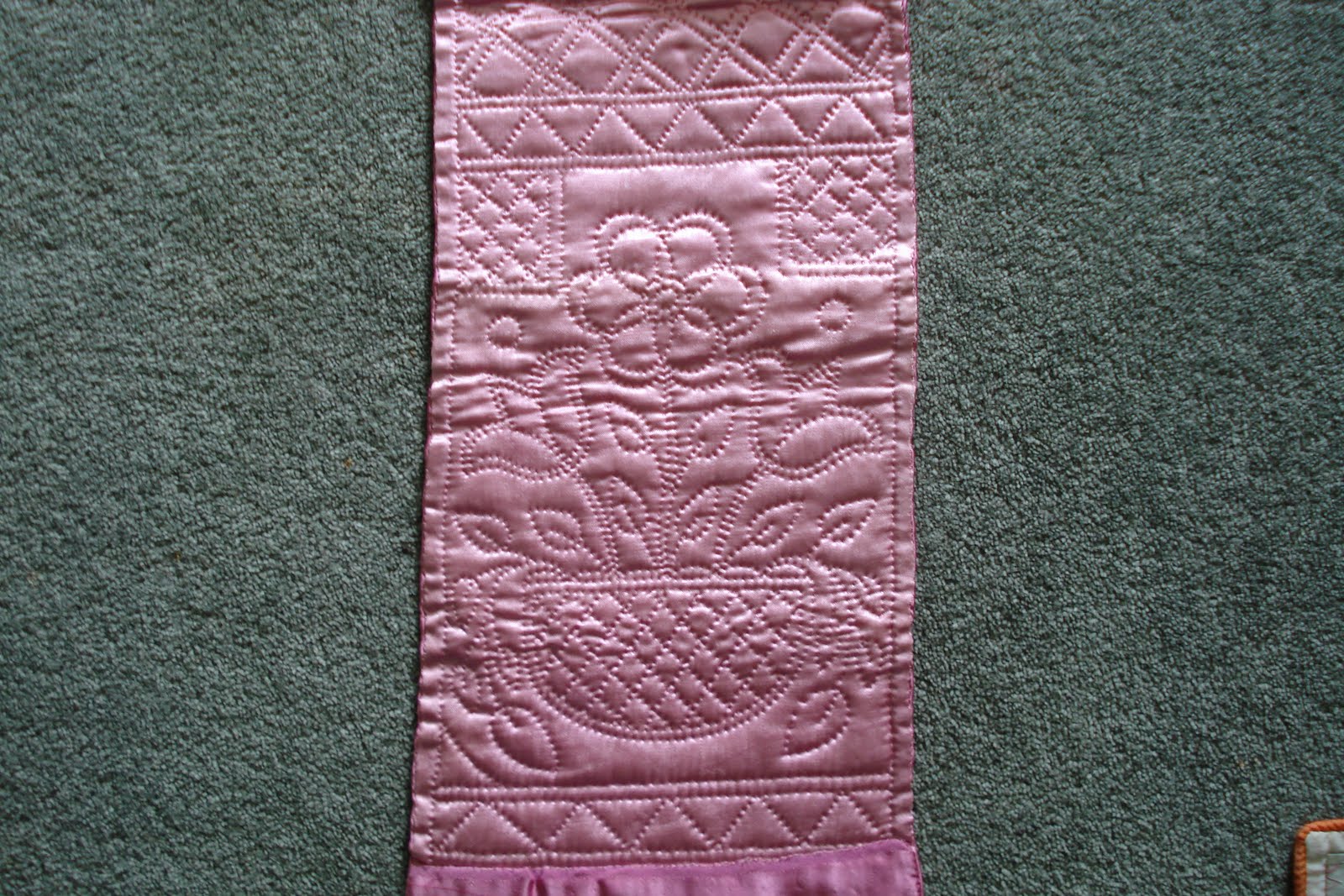
You may remember this sample of quilting that I mentioned in an earlier post.
It is of pink fabric with a Welsh-looking pot of flowers motif. The samples came from a seller in Devon, and it was supposed that they might be Rural Industries Board samples - Devon was a hotbed of activity for the WI and several people who lived in Devon were involved in the RIB scheme.

Not long ago I had an email from Clare Claridge - "Wanted to let you know that the pink quilt in the April blog looks like the work of the Porth Quilters about 1933 under the RIB scheme, See Chris Stevens p 38 and Elizabeth Hake Fig 57"

This was very interesting and sent me off to find the two books. It was difficult to find the Stevens book - it is a very slender book and required several searches- did I actually own a copy?I finally found it.... also the Hake book. The two photos seem to be of the same quilt. Also in the Hake book in the acknowedgement, one can see that several of those thanked are in Devon - not surprising in a book concerning West Country quilts - but it does show that there was an interest in quilts in Devon before the war.

It also made me want to find out more about the Porth Quilters.

As one does, I looked with renewed interest at all the plates in the Hake and Stevens books - and made what I think is an extremely interesting find - more in the next post....

Thursday, 4 November 2010

St Lawrence Chiming Company

Here is the church that I ring at every Wednesday from 12.30 to 1 o'clock. It is St Lawrence in Ipswich, very near to one of my part-time jobs. The tower is Victorian, but the rest of the church is medieval. Like Norwich, York and the City of London, there were a lot of churches in Ipswich, of which many are now redundant. St Lawrence had a congregation until September 1974, when the incumbent startled his parishioners one Sunday morning by telling them that the church would close immediately. Ownership was transferred to the Ipswich Historic Churches Trust. Two years ago, the church was transformed into a community centre with a restaurant. The aim is to get people back into work by offering them work experience and training in the restaurant.

The bells are the oldest ring in the UK as they date from 1440, and are called the"Wolsey bells". Cardinal Wolsey of Tudor fame lived nearby and would have heard the sound of these bells. His uncle was a wealthy butcher with a shop nearby and funded his education. The bells are thus preReformation - and still have their original clappers and bell canons - very unusual. Two years ago the bells were totally refurbished by the Whitechapel Bellfoundry and the tower strengthened. The Borough Of Ipswich, which donated a significant sum of money to the work, asked that the bells be rung every Wednesday, and I try to do this when I am able to.

The bells go very well, but as the bell wheels are large, they go slowly and require careful striking to sound their best. But they have a lovely mediaeval "hum" to them and are nice to ring, although with only five bells there is a limited repertoire of methods to ring! The tenor bell weighs about 14 hundredweight.


George W Pipe, who is in charge of the ringing. George is one of the best ringers in the country and has rung over 1,000 peals. George expects a high standard of ringing; the church receives a lot of visiting ringers who want to ring on this historic peal of bells.

A view into the church itself - you can see the restaurant beyond the glass partition or balcony. I find the glass a bit offputting! but am getting used to it...

Sunday, 31 October 2010

Paisley fabric panels

Here is the fabric that I am intending to use on the reverse of my Welsh quilt (two lots-enough for two quilts, then). It was bought as a "vintage paisley quilt or throw" and I paid just £20 for it. The dealer confessed that it was not very old (she thought possibly 70's but definately not victorian) and did I still want it? Well, I just love red paisley fabrics, of course I had to have it!! Besides, modern repro cloth would cost more than this...

The two sides of the throw were each made of four yard long red paisley fabric panels, sewn together, to make an interesting pattern. Each side is different. The throw itself had not been used but was very poorly put together. So I had no compunction in unpicking it to reuse the fabric. Also, I was able to inspect the construction and inspect the wadding.

The throw was very simply made - the three layers had been put together, wrong sides together, and then sewn around and turned inside out (the envelope method). This was then sewn around again. The sewn edge was folded in and top stitched to make a bound edge. But it was very rucked up and had not been carefully sewn. The inside was a length of white woolen cloth with a twill weave.


The more striking design - almost gaudy...with a central star and blue flowers...


A more sedate red paisley, I will use this fabric for the first quilt...central design has a flowershaped design and the paisley is more classical in appearance...

Jen Jones has a quilt museum in Lampeter's former Town Hall - which I very much look forward to seeing one day. This year's exhibition was of quilts made with paisley fabrics and also paisley shawls...two quilts looked similar to my fabrics and were made from the paisley panels, but in different designs, of course.

I sent a copy of the two photos to Hazel at Jen Jones to ask the age of the two quilts on display - here is her answer:

"We have two paisley panel quilts in this years exhibition - the one most like your fabric has provenance and came with other quilts from the same family (different generations).

"Bold paisley Panel quilt" made in 1880 by Ann Lewis of Whitland (prolific quilting area).

The other paisley quilt has been dated as 1890. Hazel"

Now, these fabrics were popular and were likely to have continued to be made for some time. But it appeaars that the fabric is older than the 1970's - and even if not older than the 70's is well in keeping for the era 1880/1890 that I most admire. However, my feeling is that the fabric is older - the sewing did look like a treadle sewing machine(hard to explain why, it just looks that way) and may be from the 20s or 30's. It is always difficult to find good backing fabric but in this case the paisley panels will really add to the appeal, and, make the quilt truely two sided. A lucky find.....

Thursday, 28 October 2010

Little Welsh Quilts

Mary Jenkins has a new blog, which is called Little Welsh Quilts and other Traditions, it can be found at: http://www.littlewelshquiltsandothertraditions.blogspot.com/


Mary is the co-author of Making Welsh Quilts and is interested in Welsh patchwork quilts, vintage fabric, Welsh samplers and more. She is in the process of writing another book; I shall look forward to seeing this book!


Some of Mary's little quilts from her header photo -how lovely are these!!


I am looking forward to following Mary's blog.